Issue #31.1 Mardi Gras Issue: Dan Alter, Susan Stiles, Dennis Formento, Samantha Terrell
A Poem by Dan Alter
[Donald Stone on the street]
Donald Stone on the street above also had no father, where were the fathers, mom sold bottles of something out of the trunk of a car which might, if hit, explode. Sat bathrobed & TV-lit eating potato chips that came in a can. Evel Kneivel of the broken bones in star-spangled
jumpsuit on a motorcycle over canyons would teach us how to be a man. Our ramps went up, we fell, we shredded plastic wheels of pretend choppers. Our bodies wheels, stones to skip: rack us up, knock us down like pins. A nice idea was boys should have men, so my mom signed up,
dropped me past the edge of town at Ed's house beside birch trees in dingy snow, wood fence giving in to weather. Rooms submerged in dog musk & smoke & aftertaste of one of the wars in Asia. Everyone seemed in a dim house to live alone, TV in the evening, more chips
from a can. Ed in his big brotherly love placing in my hands a gun. Happiness: toward empties on the fence my tiny shining bb flew.
________________________________________________________________________________________
Dan Alter is the author of two collections of poetry: My Little Book of Exiles (Eyewear, 2002) winner of the Cowan Poetry Prize, and Hills Full of Holes (Fernwood, 2025). He is also the translator of Take a Breath, You’re Getting Excited (Ben Yehuda, 2024), from the Hebrew of Yakir Ben-Moshe. He works at the Magnes Collection of Jewish Art and Life at UC Berkeley. https://danalter.net/
________________________________________________________________________________________
________________________________________________________________________________________
Susan Stiles is a freelance writer living in Croatia. Her poetry has appeared in The Lake, The Dalhousie Review, Panorama, Innisfree, Slant, The Westchester Review, and elsewhere. Recently, she joined the team at Panorama as a reader and, occasionally, she writes a blog, “Letters from Rab,” on her website at susan-stiles.com.
________________________________________________________________________________________
A Poem by Dennis Formento
Donepezil dream of such intensity I must have taken two by mistake
i
Cycling old Mid-city years ago—
my old neighborhood, on my bike—
wandering little dead-end streets
with magical decrepit houses
single shotgun gems with falling windows and peeling paint
small streets, tiny narrow neutral grounds
blue-black night-time scenes,
bright blue day!
Avoid that blue alligator
that crawled out of the bayou
crossing the street right after Dumaine
or maybe it’s DeSoto
two blocks over
where night falls, and somewhere
between Banks and Bienville
there’s a little place I’ve been to before
a coffee house of all the ages:
little families, hippies with kids
in costume, everybody’s in costume,
clowns and meatballs and mountebanks
courir de Mardi Gras ensembles
carrying little torches to light their feet
light the night.
Parents, poets
children and single people packed
into this coffeehouse
dizzying scene
the street almost tipping over
with hubbub.
But around the corner and down the bend,
police in droves on foot and horse
are rounding up the revelers,
humorless cops in black
policing the unruly electorate
after dark.
Shops,
little corner stores
packed up with friendly forces,
the street tips sideways
I lose my balance and fall—
golden rings dot the sky
and a group of someone’s friends appear:
Oh she wants me again
and she falls against me,
but the time is wrong
the sky has been dialed backwards
and she offers a gold-leaf disk called a “favor,”
marked like a solar calendar
from the Mayan-Mexican team
a psychopompic ride from one
elementary state to another.
ii
Gold rings and spheres
on blue shields
blue-gold squares
born by city marchers, swaying
thousands on Carrollton Avenue,
middle of the day and I’m flying
floating awake, amber light of sunset,
broad day looking for a place to go to school
to learn the trombone.
And I’m floating above this Uptown cinema 3-dimensional p.m.
mother picking up her son and daughters
adds to the traffic jam
and the parade
in front of schools, churches,
all these pleasant old buildings,
a synagogue or two,
kids boarding the street cars,
parades of maskers and
musketeers.
And here I am floating over the neighborhood
in an invisible vehicle,
circling the old Masonic hall,
now a music school,
and on every floor
crowds are rendering shuffle-time,
and the mass stands still while the band rewinds
patiently—a billboard in the distance
near the interstate has changed, it’s a movie,
and hovering over the building like a crow,
over the school to get a sense
of its suitability,
how could I know
watching a lanky 16-year-old
emerge from the old brick pile—
if I would be happy there?
There’s so much glittering gold in the street
an airplane shuffles by,
so many worlds to be known.
Memory is capacious
but incapable of recalling
all the surfaces
in this scene
that glitter and glow.
Sunday, 2-23-25 3:08 a.m.
________________________________________________________________________________________
Dennis Formento: Books include Phaeton’s Wheels (Lavender Ink Press, 2024); Spirit Vessels and Looking for an Out Place (FootHills Publishing 2014/2010); Cineplex (Paper Press, 2012). Edited bioregional magazine, Mesechabe: The Journal of Surregionalism, 1991-2001; founded Surregional Press, publishing Darlene Fife’s memoir, Portraits from Memory: New Orleans in the Sixties (2000), John Sinclair’s Fattening Frogs for Snakes: Delta Sound Suite (2002), and Ungulations: Ten Waves (Under the Hoof) by A. di Michele and Amy Trussell, 2011. Founded 100,000 Poets for Change, New Orleans and Northshore chapters, a world-wide movement of poets and other artists for social change and ecological sanity, 2011/2015.
________________________________________________________________________________________
________________________________________________________________________________________
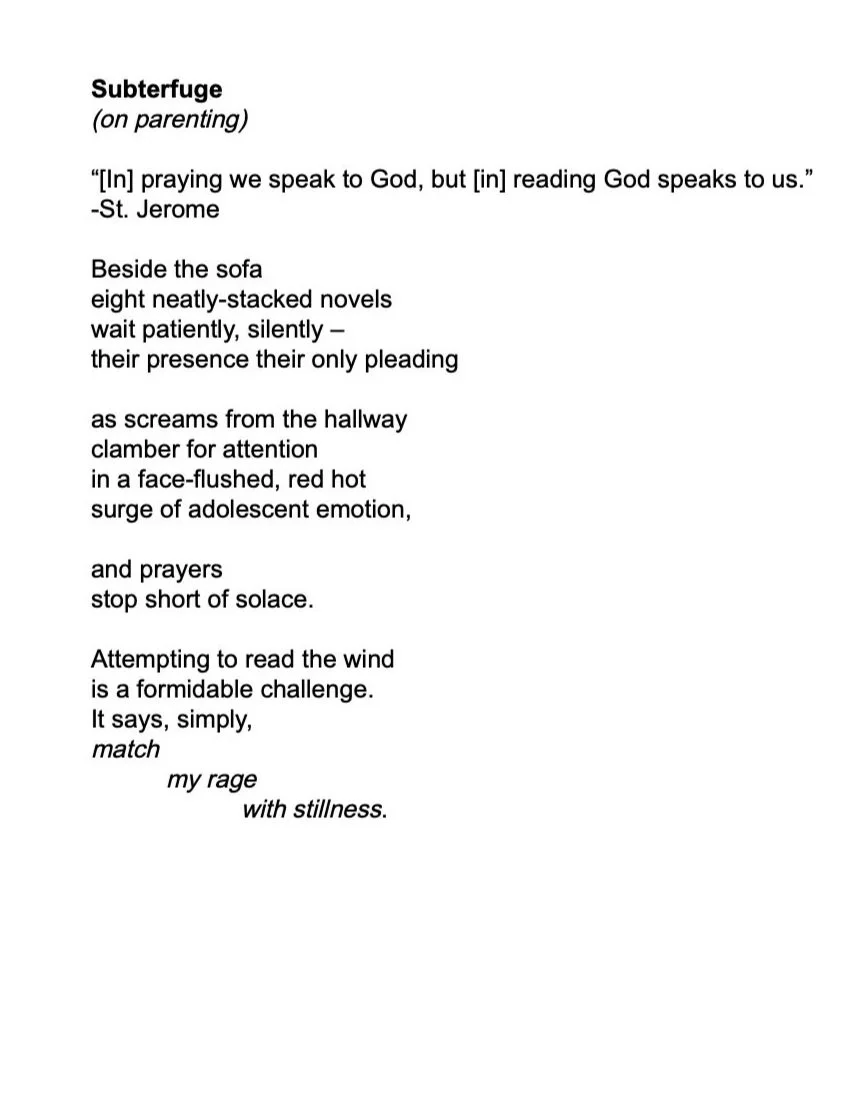
Samantha Terrell is an American poet whose work has been widely anthologized, recently in Fulcrum Review, haus-a-rest, iamb poetry, and Locust Shells Journal. Her collections have been published by indie presses in the US & UK including Alien Buddha Press, JC STUDIO Press, Low Hanging Fruit Publishing, Vellum Publishing UK, and others. Terrell's poem “Nor Should We” was shortlisted for The Letter Review Prize (Summer 2025); she has been a Poets & Writers grant recipient; and she is the founding editor of SHINE international poetry series. Terrell resides with her family in New York State.
________________________________________________________________________________________
Issue #31.2 A Triple Issue: Francesca Leader, Georgi Bargamian, Darren C. Demaree
A Poem by Francesca Leader
I Am Duck Phillips in Mad Men Season 3, Episode 12
Peggy’s at the door of Duck’s hotel room when they announce that JFK’s been shot, & Duck unplugs the TV, pulls Peggy inside & kisses her, & they have their nooner before either of them must face what’s happened, because I think Duck knows that the world has always been burning— that it was sabretooth tigers and gum-rot before it was plague and famine and war. I think Duck, like me, is long past stopping for any flame not fed on bliss.
________________________________________________________________________________________
Francesca Leader’s poetry and CNF have been published in One Art, Pithead Chapel, Abyss & Apex, Broadkill Review.
________________________________________________________________________________________
A Poem by Georgi Bargamian
Bruised fruit is sweetest
We laughed when you
announced that you’d eaten the
abandoned bruised pear:
one more food rescue
by a Depression-era kid. But now
I see your kinship with
broken enzymes and the
last fruits to be picked, the
tenderness in your rescue, the
ghost of you slicing
wounded flesh knowing
bruised fruit is sweetest when
eaten uninhibited and alone.
________________________________________________________________________________________
Georgi Bargamian was a 2025 International Armenian Literary Alliance mentorship program mentee. Her poetry has been published in The Armenian Weekly, The Cincinnati Review, PoetTreeTownA2, The Songs of Summer poetry anthology (Waters Edge Press, 2025) and elsewhere. She lives in Ann Arbor, Michigan.
________________________________________________________________________________________
A Poem by Darren C. Demaree
Emily as She is Beautiful and She Laughs
We all spend teeth in the self-wolf economy. She kneels to smile
& I start a revolution. She sings to saint us. Nobody will ever know
she saved a world. Everyone will know why I try so hard to do the same.
________________________________________________________________________________________
Darren C. Demaree is the author of twenty-four poetry collections, most recently “Now Flourish Northern Cardinal”, (Small Harbor Publishing, November 2025). He is the recipient of a Greater Columbus Arts Council Grant, an Ohio Arts Council Individual Excellence Award, the Louise Bogan Award from Trio House Press, and the Nancy Dew Taylor Award from Emrys Journal. He is currently working in the Columbus Metropolitan Library system.
________________________________________________________________________________________
Issue #31.3 A Triple Issue: Riayn Spaero, Katie Kim, Shannon Guglielmo

Two Poems by Riayn Spaero
When I say tender skin, I mean
a blues guitar cover of “Lady Picture Show,” and En Vogue’s “Don’t Let Go,” spare and decadent as a hip bone carving a path in flesh, and “Mercy
of the Fallen,” lo-fi, only two presses— yours, mine—one master with all the rights,
all permissions. and, “The More You Ignore Me, the Closer I Get” without trepidation in fingering, strokes, or breath control for blessing a need progress spoiled to toxicity— pluck a little poison into me, sing until my walls reverb the hazard coded in your tone. an amplified
list of fine watches, culled to overwhelm but not pin down my wrist—break it down for me like I’m five, but don’t make me feel my five; life careened to a sparrow’s-eye view, all numb, everything and nothing’s bothering me without warning at five. a whisper to break the tie between which face sweetens
what I lost, ran out, and can’t make up.
a canceled appointment. a ditched flight. an ear. a lie
from goodness and mercy. a ride down Mulholland to head off panic’s rise in my chest, winding inside audible lines and crushed stones to catch breaths above dimmed stars and night- lights of a sleep I couldn’t dream hard enough.
a sternum to emboss the sinews tethering my shoulder blades.
an atonement bloodier than your offense.
my word before your flesh, blood, and water bodies, bodies, bodies.
the other ear.
Your rough patch, for my aloed hair; exit wounds, for my milkweed and honey, offering, pressure, release.
Apart from the Body
As told by vertebrae L4 and 5:
Senna, h r sentence, desire persists.
Else for what to expect of we remains of a wom n named High Witch, first, then Queen Mary between what swelled bosoms endow
and what drowns—blood’s erosion through its current’s rush against our collective. We tried to gasp, but could only twist 35⁰ off the center h r scapula and pelvis now feign
to straight up stand—oh, yes, we were where? Else for what to expect of our wom n, our whittled g rl, than to insist, Not I, the breach was his contact, his caterwaul, sucked teeth, fss-fss hiss to a pussy cat who’s cast and trampled her purr in sand?
What to expect of Most High Witch Queen Mary, but beg our strength to deliver his soul
to pocked asphalt, engine exhaust, kabob smoke, manly spit, drunken piss, pigeon shit, phlegm, and ingest
loss dislodging his face and gratitude’s quickened ex- hale for skidding tires, honked horns, curses and wails without impact.
________________________________________________________________________________________
Riayn Spaero is a writer and performance artist. Her work appears or is forthcoming in CALYX Journal, Artemis Journal, Rogue Agent, Autofocus, the Under Review, New Feathers Anthology, LIGEIA, Major 7th, and The Believer. She's had the privilege of reading her work at The Elizabeth Street Garden & McNally Jackson Summer Poetry Reading series as well as the Frank Conroy Reading Room at the Iowa Writers' Workshop, where she recently attended their summer intensive. Spaero is still learning to embrace changes to her plan, while reconnecting with her culture's healing arts and languages and drawing upon the words and rituals of her grandmother.
________________________________________________________________________________________
A Poem by Katie Kim
Hangul Abecedarian for Halmoni
after Franny Choi
Gone: the smoothness between the syllables of my name. Her fingers unbraid knots from the century she still lives in—a century of hanbok and yeot.
Dying legs folded beneath her, she’s stubborn as the baskets filled with laundry from Dad’s marathon. She sits beside me, close enough to smell my lice shampoo.
Most days she asks me, What you eat today? Every day, another photo of banchans on my plate. She worries the vegetables she sends home won’t fill me up.
Licorice stains the inside of her suitcase black, leftover from her trip. I think she’s forgotten I don’t leave Korea for four more days, mailing letters I’ll open when I return.
Germs! Halmoni says each time she scrubs my hands with hers, thumbs pressing circles of soap into my palms. In her eyes, I’m still five & struggling to reach the faucet.
Can you leave my room? I asked once. The words didn’t sound like mine, so I typed, I’m sorry, even though she still doesn’t know how to check Messages.
Pausing before I enter the kitchen, I rehearse: mi-yan-hae-yo. I see Halmoni smile as she places chopsticks beside the noodles she cooked for me, still warm.
________________________________________________________________________________________
Katie Kim is a student attending Deerfield Academy in Deerfield, Massachusetts. As a writer, she is particularly interested in poetry and realistic fiction. Her work has previously appeared in Saranac Review, Little Patuxent Review, The Spotlong Review, and elsewhere. She is an alumna of the Sewanee Young Writers’ Conference, the Juniper Institute for Young Writers, the Advanced Ellipsis Writing Workshop, and the Adroit Summer Mentorship Program. As well as creative writing, Katie enjoys visual art and playing the oboe.
________________________________________________________________________________________
Two Poems by Shannon Guglielmo
Hüzün (4 weeks pregnant)
When I decided to procreate I realized I’d lost all my ancestral knowledge:
the moon & women cycles what to chew from the ground not to cramp how the mother spider’s silk is stronger than steel.
Underneath my brocade skin-womb I am in communion with Dinah & Leah. They help me live out this sadness-bellied hope
as I hunch by the mirror sink toilet the grief-joy of those two blue lines. I want to give birth to a birth giver
to be a sacred incubator & reconnect to sonder to undulate humanness. Trying to get pregnant
gives you permission to look people in the eye & ask What are you grieving?
Fulcrum-balanced waiting pining for redemption the amongness of my mother
& grandmother & Eve. We are tied together by this hüzün.
Carmela (32 weeks old)
After Lascaux Cave Paintings, Montignac, France ca 17,000 BC
There was a woman 19,000 years ago. Her baby cried in the night. She pulled the baby close & nursed her lest the beasts hear and draw near.
She was too tired. After midnight but before dawn’s eyelash streaked the sky with carmine she felt that limb & mouth clung to breast.
Her murmuring a language we’d never be able to speak but we could understand as:
For I alone am your mother for you alone are my soul this alone is my milk stained and soured like new grass & plum skin.
The edges of her were falling apart lately, fraying heel calluses cuticles black round the rim of the nail
back teeth grinding til they nip the lip and cheek eyes washed out to gray watching eroded bluff ants in cracks sun reflected in water.
This woman speaks to me now says, You won’t regret the sweet days of youth sucked from you to feed your baby’s soul.
Take my faith until you have time to believe.
________________________________________________________________________________________
Shannon Guglielmo is a poet and math teacher in New York City. Her recent work is featured in Rogue Agent, Bombay Literary Magazine, Right Hand Pointing and Willows Wept Review. She is the founder and organizer of a no-fee poetry workshop that connects poets from New York and Massachusetts to strengthen their craft. She is a recipient of the Fund for Teachers Award and the Math for America Master Teacher Fellowship.
________________________________________________________________________________________
Issue #31.4 A Triple Issue: Heather Truett, Salvatore Difalco, Russell Rowland

A Poem by Heather Truett
Viper
sank in fangs, then tried to flee, but I remember his name, his slit eyes, the flashing of a fast tongue that brought no pleasure. My blood boiled over. All his slithering came to naught, and I walk naked into the garden. I straddle Adam bathed in ash and apples.
________________________________________________________________________________________
Heather Truett holds an MFA from the University of Memphis and is doing PhD work at FSU. Her debut novel, KISS AND REPEAT, was released from Macmillan in 2021. She has work in Hunger Mountain, Whale Road Review, and Appalachian Review. Heather serves as editor-in-chief of the Southeast Review. Find out more at www.heathertruett.com.
________________________________________________________________________________________

A Poem by Salvatore Difalco
Game Seven
Going on in silence behind me matters to millions, it matters to me in passing, but I grind my teeth meanwhile, my armpits lather. I’d laugh if not alone, it always makes me feel a little sorry for myself when I laugh aloud by myself. But I hear cheers from next door or groans depending how the bats swing. And yes I’ll tango in the streets when and if the time comes. Who am I to keep my own council when victory unites the citizenry? Is it only triumph that we seek, or sportsmanship, that human feeling thing, that overcoming as a team? It matters how we frame the game. It matters and it doesn’t matter. But enough with the tiptoeing. Give me victory or give me death is the theme of this rap.
________________________________________________________________________________________
Poet and Storyteller Salvatore Difalco lives in Toronto Canada. Recent work appears in Journal of Compressed Arts, E-ratio, and Cafe Irreal.
________________________________________________________________________________________

A Poem by Russell Rowland
Nocturne in C Minor
This is the red fox’s time to see but not be seen; and the unblinking owl overhead; and the binocular moon above all. Since we do not have eyes
like theirs, we just go to bed. Still, it is an hour suitable for hindsight, back to dead-letter days, cold-case days, still on our consciences.
What was said and done we realize might have been said and done better. (Oh, the child’s teary face; the doors slammed on our apologies.)
Dark hour too of foresight: what we see coming, what form it takes once it arrives. Whether good is said of us, when we present accounts.
We do fall asleep, until morning breaks. Fox and moon slink away, owl flaps off into woods still shrouded. The sky, protective, hides its stars.
We dress for the forecast, put on our eyeglasses if we need them, decide which bills to pay— transpose to C Major, as long as it’s day.
________________________________________________________________________________________
Russell Rowland writes from New Hampshire’s Lakes Region, where he has judged high-school Poetry Out Loud competitions. His poetry books, Wooden Nutmegs and Magnificat, are available from Encircle Publications. He is a trail maintainer for the Lakes Region (NH) Conservation Trust.
________________________________________________________________________________________
Issue #31.5 Three Poems by Dolo Diaz

Dead Nun in Voronet
The painted monasteries of Bucovina.
The impossible blue of Voronet, called
Voronet blue. Pitch dark night, the azurite
had faded in the outer walls. Loud ruckus
in the back of the building, at the cemetery.
Nuns chattering, clanking, digging, for vegetables
we thought, a grave as we found out.
The dead nun’s sisters take it in stride and celebrate,
she is with her beloved, or at least on her way.
The monastery is still open, so we go inside.
It is dark, the kids bump something in the aisle,
the dead nun. In her coffin, one last night of prayer.
Before her sisters come for her,
grab her and lower her into the fresh, cool ground.
Not unlike planting a colossal bulb
they’ll never live to see sprout.
Around My Finger, the Ghost of a Squirrel
The low bungalow on Melville St has my wedding ring in there somewhere. I slipped it off my finger, held it in my hand, and it disappeared. It had three tiny diamonds and three tiny sapphires, six my lucky number. Custom-made in an old store in downtown Seattle. The most likely resting place was the planter box in the backyard where I was trying to grow lettuce, where a black squirrel would sit gorging on the tender leaves and leave nothing but the stalks. A squirrel I captured in a metal cage with bait of cheese and carrots. I found him trapped and terrified one day after work and drove him to the hills, breaking the law with wildlife in the trunk, and left him there amongst familiar trees but away from home and kin. That ring was irreplaceable, so I did not try, bought a cheap silver one that turns dark in the pool. When I see it changing color, I think of that squirrel.
Birthdays with Matches
I never gave a damn about my birthday—
good, since Mother forgot sometimes.
Days later she’d pour off the cream
warmed by the woodstove, skimmed daily
from our cow, and bake a rock-bottom cake:
egg-yolk yellow, no frosting, no frills.
I begged for candles; she struck matches,
planted them in the crust and set it down.
No ceremony—smell of sulfur, quick flames,
and all of us leaning in to blow.
________________________________________________________________________________________
Dolo Diaz is a scientist and poet with roots in Spain, currently residing in California. Her work has appeared or is forthcoming in The Summerset Review, The Woolf, ONE ART, Rogue Agent, among others. Website: dolodiaz.com.
________________________________________________________________________________________
Issue #31.6 A Triple Issue: Naa Asheley Ashitey, James H. Duncan, Sally Huggins Toner

A Poem by Naa Asheley Ashitey
Fables and lessons
I fell on top of four broken hourglasses in the hallway. I stared at the single shard Of glass, the single piece that somehow pierced The little bit of skin my sock didn’t cover of my ankle, And now found a temporary resting place. I held my breath knowing the pain that was going to come Once I would pull it out, and the second and third stages of pain That would come with the alcohol wipes and the bandage. I found myself even more upset at the thought cleaning up after myself, cursing at the fact that taking the glass out would cause more pain than leaving it in; more blood to drip down my ankles to the sides and the creases of my feet; the awareness of the risk of infection, necrosis and apoptosis all at once. I am left burdened with more to clean, fix and watch as the skin slowly heals over the next few days or months; all while the piece of glass that injured me will simply just end up in the trash, alongside the other glass pieces, grainy sand, and uneaten lunches from the coffee stand.
How is that fair?
________________________________________________________________________________________
Naa Asheley Ashitey is a Chicago-born writer and MD–PhD candidate at the University of Wisconsin–Madison. A first-generation, low-income Ghanaian-American and University of Chicago alumna, she writes at the intersection of race, medicine, and belonging.
Her creative and editorial writing examines how policy, media, and academia reproduce structural violence—and what it means to resist with truth.
Her creative work appears or is forthcoming in Eunoia Review, BULL, Hobart, Michigan City Review of Books, and editorials for The Xylom, MedPage Today and KevinMD. She has been nominated for multiple awards, including Best Small Fiction. More at NaaAshitey.com.
Twitter/Instagram: @foreverasheley
Bluesky: @foreverasheley.bsky.social
________________________________________________________________________________________
A Poem by James H. Duncan
Variations of Blue
from these cliffs, the North Sea absolves
there is nothing here but variations of blue the stones and the seas and even the way the grass changes color to match the sky when it rains across alpine tundra—there’s nothing here, they say, but that’s the point
with no disease, there’s no need for a cure there’s no need for anything but oceans rounding stones into sand, wind buffeting across generational miles and the long embrace of nights safe from depredation
in a land of nothing but variations of blue
________________________________________________________________________________________
James H. Duncan is the editor of Hobo Camp Review and the author of Talavera Sunsets, Cistern Latitudes, Both Ways Home, and other books of poetry and fiction. He also writes about indie bookstores for his blog, The Bookshop Hunter. For more visit www.jameshduncan.com
________________________________________________________________________________________
A Poem by Sally Huggins Toner
Joker
My cousin beds Joker down in his stall, spreads fresh hay over dung, fills his water, brushes him sleek and clean—an apology, perhaps. Earlier— she made him pay. She took the reins, lashed him the kind of hard that comes from fear as much as rage. She knows she’s in for it when her daddy finds out, and his leather has a buckle on the end. The horse took off with me on top. She promised she wouldn’t let me ride him by myself. I swore I’d ridden before, but that was just at summer camp. Those ponies weren’t rescued from the rodeo. They weren’t built for speed like him. I imagine, before he goes to sleep, Joker curling his Mr. Ed lips into a grin when he considers how he almost threw me from his back—a towhead a quarter of his quarter horse size, with sturdy, stubby, barrel racing legs just like his. Before I go to sleep, I’ll feel my fingers as they squeezed the straps, pulling hard against the bit until my nails chewed the softness of my palm— how I wasn’t strong enough raise his head. I’ll recall how he picked up speed, my cousin too, how she screamed as we charged the front of her house. How my aunt came out. How she stood, on the step, much taller than herself held up her hand, palm facing Joker’s ornery eyes. How he skidded to a dusty halt. Years from now, my cousin will abandon cowboys, outlaw behavior. She’ll replace blue jeans and boots for nurses' scrubs, a stable of children, grandchildren of her own. No one will remember Mr. Ed on black-and-white TV. Neither will my aunt. She won’t remember Mr. Ed or Joker. She won’t remember me when I see her in the nursing home where she’s bedded down. The one my cousin and her daddy chose so carefully. They’ll cut her hair short and sleek and clean. My uncle will place a baseball cap so gently on her head—an apology, perhaps. She’ll laugh, say he’s cute. When he tries to take a cookie from her packet of Milano’s, she’ll flash her ornery eyes for just a second; then she’ll snatch it back. She’ll put a hand on my cheek, call me pretty. I’ll take her other hand in mine, turn it over, stroke her palm, remembering how soft and strong it always was. That, at least, will feel the same.
________________________________________________________________________________________
Sally Huggins Toner (she/her) has lived in the Washington D.C. area for over 30 years. Her poetry, fiction, and non-fiction have appeared in Northern Virginia Magazine, Gargoyle Magazine, Watershed Review, and other publications. Her chapbook Anansi and Friends was published by Finishing Line Press in 2019. She received an MFA in narrative nonfiction from the University of Georgia. An empty nester with two grown daughters, she lives in Reston, Virginia with her husband. You can find her at sallytoner.com, @salliemander.bsky.social on Bluesky, https://www.linkedin.com/in/sally-toner-65290346/ on LinkedIn, salliemander70 on Instagram, and on X at @SallyToner
________________________________________________________________________________________
Issue #31.7 A Double Issue: Sara Schraufnagel & Stefene Russell

Four Poems by Sara Schraufnagel
Not in Uniform
Shelly’s mom found the clothes with holes crumpled up in the back of the closet. She put on the ones from Hollister, smelling of body dysmorphia and perfume. The lace tank top that would show off Shelly’s massive boobs and her mom's flat stomach stretched like plains down to her hip bones. She took off her pants, now wearing the low-rise skirt that barely covered her ass. She walked like a runway model, making the holes from the sensors deeper, twisting other clothes around her fingers, mocking us. Our futile attempts to wear something on non-uniform days that my parents wouldn't buy for me and her mom couldn't afford. She dug her fingers into the makeup we hid in our underwear from the department store. Turned around with blue eyeshadow and berry lips. Look how good I look. She had a point.
First Job
We are behind the golf shop by the dumpsters, pretending we don't have to go back out on the course or replace the Miller Lite the middle-aged men love. Or maybe it’s just getting away from their wives and kids.
We have five minutes to pee, reapply lipstick, press down the wrinkles in our little white skirts. I’m waving my hands under the dryer. It takes too long. The same motion I'll use to clear cigar smoke from my face, the same motion I'll make when they say, Put one down for him, let’s see your swing, little girl.
Shelly gets more tips. She’s a performer. Sticks her butt out and winks. What’s to come translates into dollars in her bank account, or those soft green bills we'll count in the parking lot.
What Are You Gonna Do
Shelly’s mom was sitting in an Adirondack chair up north, and she patted the sandy blue one next to her for me to sit down.
Lit me a cigarette with the one in her mouth. You girls get into the Maker’s Mark yet? No, ma'am. Oh, you will. The mosquitoes were eating us up, but I didn’t mind
I just liked being close to her. She stared ahead. Cicadas chirping at the lake with its navy horizon. What are you gonna do in a couple years?
she asked, meaning when I graduated high school. I want to move to California and be a journalist. With that, she coughed up her drink. It went down the wrong tube, just like my words.
She was laughing hysterically, her varicose veins rising on her bony legs, slapping her thigh until it went red. Oh, look at you, she said. Just look at you.
The Coming and the Going
When I slept over at Shelly’s house, I could hear her mom come home from the night shift.
She’d start the shower, ready to slip into the mint green tile. Her tattoos putting on a show in the dirty mirror.
Scars visible from birth, scars from him, scars from her. The snake tattoo danced, but it was nothing like his—
the ones from Afghanistan. He was nothing like the boys she’d imagined as a girl,
the ones from bands she cut out of magazines. She’d come home often, eyes glazed over,
leaving again to go on a walk with wet hair and menthol cigarettes tucked under her boobs.
She left us behind then, and eventually every day that summer. Her voice would ricochet off the front door,
and she’d say things like, There are a lot of creeps out there, as we left the house wearing practically nothing,
into the darkness of the neighborhood, hoping something would happen, hoping that we’d get noticed.
________________________________________________________________________________________
A poet living in Colorado, Sara Schraufnagel has published work in The Offing, Sonora Review, Jet Fuel Review, The Fourth River, Slipstream, and Midwest Quarterly. Her work also appears in a number of other publications.
________________________________________________________________________________________
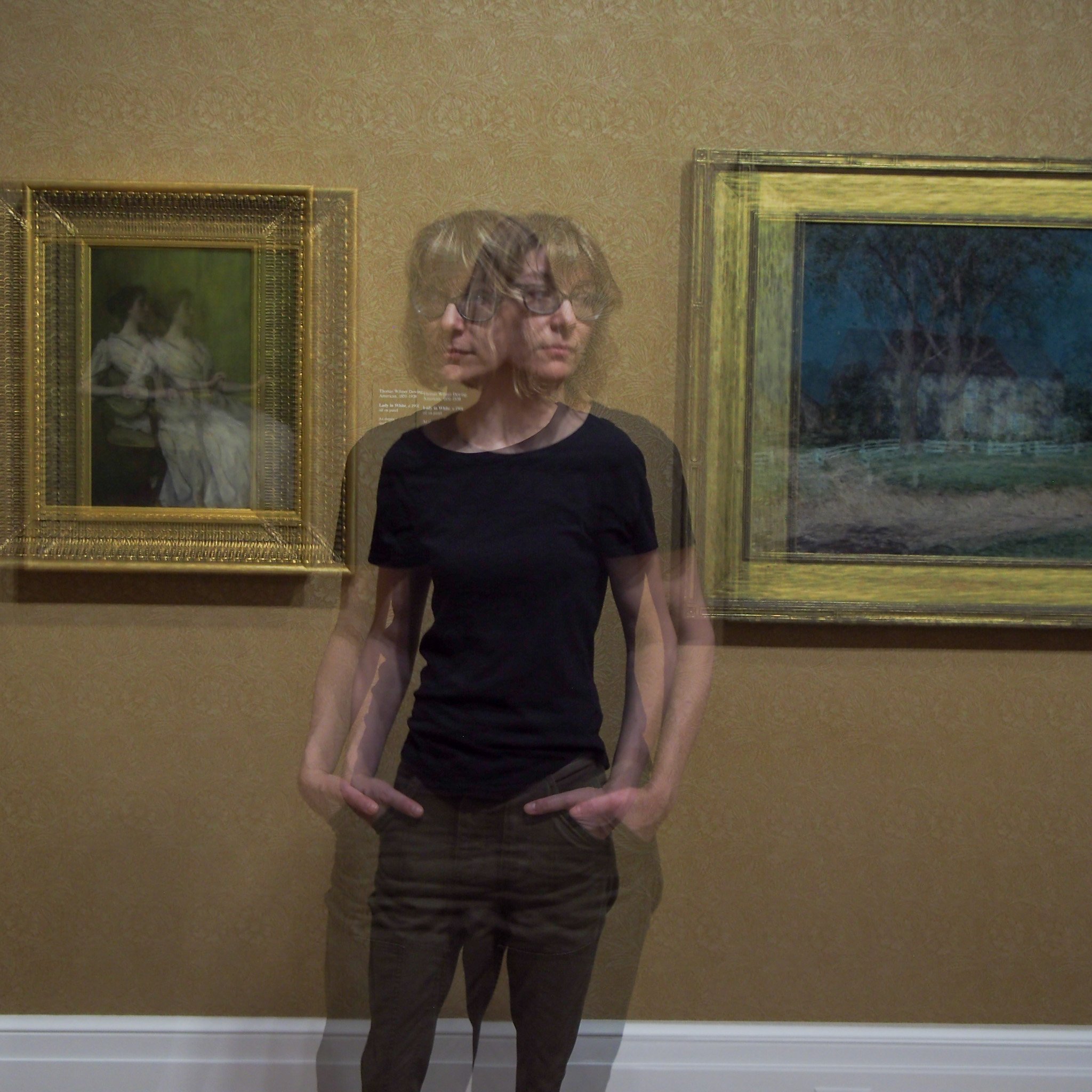
Photograph by Tiff Sutton
Three Poems by Stefene Russell
Solfège
solfège: (noun) sol·fège säl-ˈfezh. 1: the application of the sol-fa syllables to a musical scale or to a melody. 2: a singing exercise especially using sol-fa syllables. also: practice in sight-reading vocal music using the sol-fa syllables. —Merriam-Webster Dictionary
I grew up in Utah, where people baptize the dead.
I grew up with people who wear ritual garments under floral dresses and navy-blue suits. Brigham Young told his flock when they crossed the plains:
"I want you to sing and dance to forget your troubles." Each night, Mormon pioneers circled their wagons, stepped into the round, and sang. Search online, or ask your Mormon friends about "merry-go rounds," and/or "road shows." I know a poet who served as proxy for Marilyn Monroe at a baptism for the dead. Because I grew up in Utah, I believe in everything. Proxies get dunked in a baptismal font supported by twelve gold oxen. Surely someone has baptized Jenny Lind, Yma Sumac, Maria Callas? Once upon a time, a woman in rural Colorado declared herself "Mother God."
Then, she became Mater Dolorosa by drinking liquid silver. Joseph Smith's first wife, Emma, wrote a hymn to Heavenly Mother. Later, the LDS church kicked out six women for singing hymns to Heavenly Mother. I understand those psychonauts who thought they could hitch a ride on a comet
by eating vanilla pudding laced with strychnine. Ti and Do, tell me: where'd you hide Re, Mi, Fa, So, and La? Utah's number one agricultural crop is alfalfa, which is fed to cattle. I don't understand The Brethren church.
They sing every night, but think pictures and stories are evil. Joseph Smith said, hot drinks are not for the belly of man. Some say drinking coffee corrupts the astral body and degrades the flesh. Some say colloidal silver clears calcium from your pineal gland. I'll never be the congregant with the keycard to the church hidden in an industrial park. I'll never be the supplicant who knows the secret knock to the apartment church in Old Town. I just want to be helium — the kind that lofts the Holy Ghost.
King Salamander
Licking his mane, sleeking through wet
rocks in the creek, he chokes down violet flames in his throat.
He walks on two feet during the day. At night, he washes himself with a little
milk to break the spell.
He's albino, likes deep holes. Born half from
Adam and half not from Adam. He'll sleep in a well
if there's a bucket on a rope so he can rock himself to sleep, but he'll settle
for a clean basket
in a nice dark place. He likes cows, sheep, afternoon shadows, creeks, rocks,
leather that still smells like leather,
the shoemaker's daughter, the fisherman's daughter, the weaver's daughter, princesses, duchesses, nursemaids, milkmaids, brides, birds
singing with the voices of women, wet-nurses, shepherd's daughters, milk, river spirits, fruit-bearing trees, Turkish delight,
fish with pink flesh, early morning shadows, mangoes, clean baskets, clear water, and the whole world at night.
A Path of Totality
The Great American Eclipse shadows Kaskaskia Island for two minutes and seven seconds. I stand
in the dark cemetery with the living and the dead:
A dog named Yoda; Antoine “Butterfingers” Cassout,
drummer with the company of Montcharveaux;
and a poet I know, who recognized me first.
Every poem I’ve ever written began on the back
of an envelope marked Return to Sender.
Star clusters too small to be constellations
are called asterisms. The Coathanger contains 10 stars. The poet shows me his tattoo: the formula for
SDSS J102915+172927, a star that shouldn’t exist.
I wanted to write a love poem on the back of an envelope,
but not to him. A new star is called a protostar. When I was small, my mother took me and my sisters
outside at midnight to see an eclipse with a red moon. My mom said, a Mormon prophecy decrees that when the moon shall turn to blood,
metal birds will fall from the sky, then the world ends. Every night, every day an eclipse occurred, I worried about red moons. I don't see
metal birds today. I see swallows and pelicans, flying backwards, and a gold sun occulted behind a black
moon, its shadow shattering across the dark grass.
________________________________________________________________________________________
Stefene Russell is an MFA candidate in poetry at the University of New Orleans, a managing editor at Bayou Magazine, and a New Orleans Poetry Festival board member. She’s also an unrepentant fan of the British paranormal show "Help! My House is Haunted."
________________________________________________________________________________________
Issue #31.8 A Triple Issue: Richard LeDue, Dan Sicoli, Abner Oakes
A Poem by Richard LeDue
“A Common Lineage”
These words are the descendent of a bear carved from wood, with a look of rage probably more likely to scare away children than termites, and those uneven edges of the fur betrayed my father’s shaky hands, desperate to create something beyond a steel worker’s split shift, yet my lineage is still there, needing no historian’s footnotes, nor a genealogist’s branches, but only my memory.
________________________________________________________________________________________
Richard LeDue (he/him) lives in Norway House, Manitoba, Canada. He writes poems. His latest collection, “Existential Drunk,” will be released from Alien Buddha Press in May 2026.
________________________________________________________________________________________
A Poem by Dan Sicoli
that day
that day i became you was a day of understanding how a door opens: one of foreshadow and time splitting: of slipping steps and misreading faces: trading masks and sharing repeated sequences: she spoke of you, of me, of the other: she said you were in the room standing there with her when i was me: she insisted on reminding me that i was you: i remember the grand canyon measurements of a bed: a profound and exhausting loss of space, denying those dimensions: i withdrew into the costumed, reckless nature of you:
and yet i missed the day your feathers splayed like a magician’s deck of cards
________________________________________________________________________________________
Dan Sicoli, an editor with Slipstream, has a new collection, Slag Alley, out from Ethel Zine Press. A three-time Pushcart nominee, he's recently placed poems with Big Windows Review, dadakuku, Hobo Camp Review, Home Planet News, Hood of Bone, Steam Ticket, and Santa Barbara Literary Journal, among many others...
________________________________________________________________________________________
A Poem by Abner Oakes
The Moose
The sky gold that morning, the yellow of the wiffle ball bat, my brother and I taking turns knocking line drives into the sure
hands of the weeping willows. And the yearling moose that stumbled from the pines up from the Connecticut River
with its button antlers, mottled coat clomping down Maple Street, legs like a giraffe. Uncle Dave said yearlings are driven away
each spring by their mothers, as they prepare to calve, and from the door our mother burst out, her camera aimed
at the scene, confused moose staring at her before crashing back into the blur of the forest. Our mother’s photos were unlike
her - off-center, unfocused, a chaos of color, of movement - but it never kept her from developing her rolls at Kuehl’s Pharmacy, her picture
books littering the coffee table: Sandy’s birthday party, March trip to Boca, our anniversary, each series of snapshots as if
she bounded through her own light dappled forest, lanky and free, squinting at the sun, sweat in her eyes rainbows.
Her wedding photos were black and white sharp, she not showing yet at the altar, her thin smile what she wore the rest of her life.
In the book labeled Moose one photo stood out for its unusual clarity and in it her fingertip covered a corner of the lens
as if pointing at the moose, and years later, when we showed her, she focused and whispered, There was a moose on our street.
That night in Benchmark’s dining hall she ate first her blueberry pie, ignoring the meatloaf. Her lips blossomed blue like the summer sky.
________________________________________________________________________________________
Abner Oakes taught middle and high school English and has had poems published in the Potomac Review, the Maryland Poetry Review, the Baltimore Review, Stone Poetry Quarterly, and Thimble Literary Magazine. He lives in the Washington, DC area.
________________________________________________________________________________________
Issue #31.9 A Triple Issue: Maudie Bryant, Matthew King, Frederick Pollack
A Poem by Maudie Bryant
Ode to a Consumed Bic
Fresh out the pack, first click provides fire, blue at the root, sharp at the edge, and the body shows nothing yet: shiny, precise. A tool ready for its simple duty.
Use after use, it begins to register touch. The sticker lifts at one corner, adhesive catching skin, and the flame, still steady, grows more measured, as though the valve considers each release.
Near the end, flecks spit brief, stubborn bursts. The button barely pushes back—a soft hinge, a thin exhale of whatever fuel remains. Casing polished smooth against the hand.
Then the final strike: a clean, empty clack. A spark jumps, bright but without purpose. The flint still chips, useless now and small. Ghost-weight plastic, occupying the palm.
________________________________________________________________________________________
Maudie Bryant is a multidisciplinary artist and Pushcart-nominated poet based in Shreveport, Louisiana. Her writing explores the thresholds between grief, healing, and the material, often tugging at the unspoken edges of the human condition. She holds an M.A. in English from the University of Louisiana Monroe, and her work has appeared in Progenitor, Welter, 3Elements Review, and other journals. Maudie is also the founding editor of Audi Locus, an online poetry journal. She balances her creative life with full-time work and motherhood, creating from the margins and making meaning from what lingers there. Find her at www.maudiemichelle.com
________________________________________________________________________________________
A Poem by Matthew King
Lost Keys to Desert Dreams
I keep keys like calendars in case they’ll be good again some year. Does anybody ever throw away the key? How can you tell them apart; how can you be sure the lock isn’t still around somewhere? Sometimes you know exactly what a key was for and won’t be again and this is why you’ll never throw it away— Mom’s oval Oldsmobile, Dad’s angular Dodge—though hanging on to the actual keys themselves is hardly required to keep them alive for you: they would appear precisely as they were, down to each tooth, in a dream, if you dreamt of
keys. We want to say a dream is a key, we want to say a key’s needed to translate a dream, we want say “I am Joseph and I alone have the universal key: bring me all the illusions troubling you and I will tell the truth they’re made of.” But King Nebuchadnezzar unlocks Pharaoh’s folly for us: you may have found the key lying on the ground, or lifted it from a wire where it was hung for fortune to deliver. Nobody’s pocket contains the right key except Joseph’s but Daniel alone describes the kingdom’s beclouded door.
I keep drawers full of answers, like we all do. In opaque containers we set questions at the curb to be trucked off, crushed, not sanitized even, simply buried to become desert ground. On this we stretch our cities into the sea.
________________________________________________________________________________________
Matthew King used to teach philosophy at York University in Toronto, Canada; he now lives in what Al Purdy called "the country north of Belleville", where he tries to grow things, counts birds, takes pictures of flowers with bugs on them, and walks a rope bridge between the neighbouring mountaintops of philosophy and poetry. His photos and links to his poems may be found at birdsandbeesandblooms.com.
________________________________________________________________________________________
A Poem by Frederick Pollack
Early Show
It’s like being made an audience for robots. Robots as we know are specialists: headless, all limbs and pincers with a hard drive. But it’s as if they got together to produce the tubular metal guys we sort of wanted. These dance.
The alternative to watching is to roam the building, where piles of tools, materiel, odd painted bits and fragile, impetuous furnishings try to pass themselves off as rooms. Is your reaction being watched? Does that change it? There may be bottled
water in those baskets. You return to the performance. The music is electronic, the sort of annoying noise humans create in summer (sawing) and in winter (scraping).
Why this? you wonder. Is it satire? Of us? The robots have stopped dancing, seem to be attempting something like drama, or at least emotion: “Was I never real to you?” “You were always real … ”
________________________________________________________________________________________
Frederick Pollack is the author of two book-length narrative poems: THE ADVENTURE and HAPPINESS (both Story Line Press; the former reissued 2022 by Red Hen Press), and four collections of shorter poems: A POVERTY OF WORDS, (Prolific Press, 2015), LANDSCAPE WITH MUTANT (Smokestack Books, UK, 2018), THE BEAUTIFUL LOSSES (Better Than Starbucks Books, 2023), and THE LIBERATOR (Survision Books, 2024). Pollack has appeared in Poetry Salzburg Review, The Fish Anthology (Ireland), Magma (UK), Bateau, Fulcrum, Chiron Review, Chicago Quarterly Review, etc. Online, poems have appeared in Big Bridge, Hamilton Stone Review, BlazeVox, The New Hampshire Review, Mudlark, Rat’s Ass Review, Faircloth Review, Triggerfish, etc. Website: www.frederickpollack.com.
________________________________________________________________________________________
Issue #31.10 A Triple Issue: Lee Lemond, Laura Sheahen, Strider Marcus Jones
A Poem by Lee Lemond
Cassie
A kettle of Turkish coffee. A stare. A cute couple.
This podcast won’t end. As if I’m even listening. Does anything ever end?
It seems we’ve reached a time where the news cycles, the sun cycles, and bikes cycle. Too many cycles. Why are bikers so rude? Why can’t the sun make up its mind? Why can’t I turn the news off?
The eavesdropper forever eavesdropping. The philosopher always philosophizing. Man forever man-ing. Man forever trying. Man. An eternal recurrence of mediocrity. Or Eternal recurrence, but make it mediocre.
Why did I walk in the cold to sit in the frozen stare of the person across from me? “Get on with your ‘work,’ so I can get on with mine!” I say with an angry scowl.
‘Oh, how I wish I had said that,’ I think with a reluctant smile.
The soundtrack inside my mind even cycles. Reality. Imagination. Reality. A dream. Another fucking cycle.
In my mind, there’s a place where life is linear. We never have to pass the same test or cross the same fork. There’s always a new coffee shop, instead of the same old boring brick building with the same old black and white menu. What even is a flat white!? The “Demon’s Question.”
Give me your poisonous decaf and I’ll trade you my soul. The Buddhists say we’ve all been each other’s mothers. I’m tired of being a mother.
More repetition. More conformity. When all I want is to trade in my awkwardness for a chance to live… Awkwardly.
Do I know him? Or do I know everyone? The Stranger question.
Have there been so many cycles that I’ve met all the world’s variety? I’ve certainly read all Variety. Each page, the same.
I can’t even focus. Can anyone focus on days like today? I should’ve grabbed Insomnia. This life feels like insomnia. The podcast has been over for hours anyway.
A cosmic rerun on another broken screen. I could literally scream. The déjà vu we call living. This can’t be living. The universe feels like it’s on repeat. I’m pretty sure this ‘Coffee House’ playlist has been on repeat since I first tried a macchiato.
Finally, I pour the last of today’s kettle, While considering what I’ll choose tomorrow from that black and white menu. Finally, I resign myself to tomorrow, Knowing exactly what I’ll choose.
If repetition is reality and life this serious, why am I out of coffee?
And since you’re wondering -- yes, he’s still staring. I fall into another pathetic smile. Hell. Other people. Or something like that.
________________________________________________________________________________________
Lee Lemond is a queer writer and yoga and meditation teacher from New Orleans, Louisiana. They write poems and essays on philosophy, life, and spirituality. Instagram: @yogawithleenola; Substack: Here for the Experience
________________________________________________________________________________________
A Poem by Laura Sheahen
The Voodoo Doll Wakes Up
the voodoo doll pulls thick needles out of her stuffing fills the syringes unwraps foreign hair from her throat settles down in her lab
on a clinical scale weighs your grievances maledicts rage
at her bench with her button eyes blinking green test tubes of potions her cross-stitched lips set
what she needs is precision she must centrifuge truth
no space to confuse the real villain and victim no mixed human error
where does DNA fail in contaminate samples on her arms on her legs your dark fingersmudge too
________________________________________________________________________________________
Laura Sheahen is an American poet who spends part of her time in Tunisia. She has traveled widely in Asia and Africa as a writer for humanitarian aid groups. She has also written arts and literary criticism (collected at LSheahen.substack.com) for The Irish Times, ArtsFuse, World Literature Today, and other publications.
________________________________________________________________________________________

A Poem by Strider Marcus Jones
Forage in Me
forage in me amongst the dunes still damp in sun and wind as the tide retreats- for driftwood and strange shaped pebbles. where have they been, these abandoned voices, with colours and textures, wild and domestic, moving and rooted, sooting and scenting the air- being engraved by beauties and conflicts, uncovering how love is only rented jumping ship when it sights new land. inner changes, have not changed anything out there- and when what moved in is all moved out, we can sometimes sit in this displaced time, with drifting belongings and pebbled thoughts, aware of strangers moving slower than the clouds deliberately doing the same.
________________________________________________________________________________________
Strider Marcus Jones – is a poet, law graduate and former civil servant from Salford, England with proud Celtic roots in Ireland and Wales. He is the editor and publisher of Lothlorien Poetry Journal https://lothlorienpoetryjournal.blogspot.com/. A member of The Poetry Society, and nominated for both the Pushcart Prize x4 and Best of the Net x3, his five published books of poetry https://stridermarcusjonespoetry.wordpress.com/ reveal a maverick, moving between cities, playing his saxophone in smoky rooms.
________________________________________________________________________________________
Issue #31.11 Three Poems by Matt Turner
from 6AMING
8:14-8:23
thruway – blooming there, surprise – broadened every direction a kind of openness, flat or tall, for habitation
like a maze across a face. Mouth in a permanent twitch – rection – set in, in every time – lazily the bus coming to a halt, turning around the military arts troupe theatre the water basin the crap scenery –
not a moment too soon, or a moment at all – litho – on the corner
8:51-8:56
wind gone, only a body can move it eyes, every time, on them the moment glued in color and fiber then relief, every time a passerby they all ascend, but no, the rest fall out divided from the participants then, grappling
in graphite, climbing the bleachers not today, probably, or ever again a synthesis, a wall, an insists
10:44-10:49
symbol – gate – guards – entrance
had not, of course, heard lamp posts surrounding the field a great lantern in the middle, in snow the grime over each tile – façade cooperative – staircase broadening the further up the building goes
natural light, at nighttime footsteps stiller, boisterous laughter somehow the puncture is on the outside inside like the center of a volcano
________________________________________________________________________________________
Matt Turner lives in New York, where he works as a freelance translator and copy editor. He is the author of four poetry collections: The Places (BlazeVOX 2025), Slab Phases (BlazeVOX 2022; described by Forrest Gander as “like voltaic charges”), Wave 9: Collages (Flying Islands 2020) and Not Moving (Broken Sleep 2019), as well as three chapbooks, including the prose memoir of his dog Xiao Chou, Be Your Dog (The Economy 2022). He is also the translator or co-translator of around a dozen books from Chinese, focusing on figures of China’s contemporary avant-garde and notably including work by Yan Jun, Ou Ning, and Wan Xia. His translation of modernist Lu Xun’s Weeds, the first English translation in 40 years, was called by Yunte Huang “a daring leap across the linguistic abyss.” Essays and reviews have appeared in Bookforum, Cha (Hong Kong), Heichi (Beijing), Hyperallergic Weekend (New York) and other journals. Poems from 6AMING have appeared in Pamenar, Voice & Verse, and Antiphony.
________________________________________________________________________________________
Issue #31.12 Three Poems by Zina Gomez-Liss
Genesis
She lifted up the hem of her skirt to reveal her inner workings. The nails of her toes glistened like gems and her feet were formed from clay still wet from verdant valleys. Small bright bells dangled from a tangle of raw silk threads wrapped around each ankle. The shiny silver polished spheres had slivered tongues that sang like a symphony. Her feet seemed to float and fall in a dance of Fate and Fortune. Her calves were striated muscle, aching sinew, chestnut horse-haired legs. Her knees were capped with burnished bronze and etched with ever intricate designs of keys and spirals bordering big beasts who ate each other whole. Her thighs were wide circumferences of white sea foam on which small galleons were tossed and lost with manifests of inky names dissolving into ocean mists. Between her legs an oyster shell opened effortlessly. Globes of glass-clear water revealed pearls so pure they tasted like fire. The iridescent drops poured down like rain upon the bells and tickled the air like the reckless laughter of unwed daughters. Her belly was full and round and speckled like a freckled eggshell. The dimple of her belly descended into the dark-deep waters where mothers drowned their grief for stillborn babies and every deserted desire. Her breasts glowed with a light as white as jasmine blossoms. Her skin was veined like glossy newly unfurled leaves. Milk streamed from her nipples like snowmelt from the steepest peaks. Her chest was flushed with the passion of Revelation. Her neck was ridiculously feathered, gracefully arching and bending and righting itself again. Her face was painted red (as would be the fashion of our people). Her voice was like the crack of whips, the ring of windchimes and the void. Her hair was black and long and coiled like clock springs pulled from grand old towers that kept the time of God. And oh my God— those long luminescent arms pulled up her silky dress in daylight. Her thin exquisite fingers clasped her hem. She threw her dress up and over the sun and put it out. The bells caught on the black satin of her slip like stars. The pearls were spaced like distant constellations. We lay upon her, had relations, and made the world by knowing her the only way we could.
final night
after Phương Anh and Huy Tưởng
I hunger for you like a flower that clings To wandering feet. I crave the scent of night, The echo of the moon and flashing sight Of spectral butterflies, their fragile wings
Like shadows shifting toward the agarwood. Recalling how you bent for what you dropped, I felt the earth convulse and time was stopped And all that ever was is gone for good.
Our glittered city turned to sediment. I think back to those yawning blooms that flowered Which on that final, final night devoured My memories, too thin and delicate.
I lie beneath a fragrant, fingered tree. A bird enchants itself—believes it’s free.
The Handmaiden
Once, out of guilt, I rashly scrawled my name For Adoration—3 a.m. was blank— A graveyard shift, a slow and silent hour. I woke that night and drove the empty streets And parked my car beside the churchbell’s tower.
I walked into the nave and crossed myself Before relieving two young women in The church. I sat not knowing what to do And, like a bad disciple, I dozed off, And here’s the dream I had while in that pew.
I saw a girl, a dark-haired teen, who stood Before a stand of fruited olive trees. Her eyes were shut. Her empty hands were cupped, Prepared to catch the rain—if it should rain. I watched and didn’t dare to interrupt.
Had Gabriel already come to her, This girl no older than my oldest daughter? She seemed at peace among the olive trees, Accepting every pain and future sorrow. It made me want to fall down on my knees…
Then, startled, I woke up, called from the dream By a young priest who gently tapped my shoulder. My hour was up. I’d done this modest task To sit before the host. Was this enough? I had no answers. Only more to ask.
I left the church and drove those quiet streets, That’s when a shower began to drum the roof And wash my way back home. I opened up My door and stepped outside and felt the rain Inside my hands—a humble, human cup.
________________________________________________________________________________________
Zina Gomez-Liss is the deputy editor of New Verse Review and a graduate student in the MFA program at the University of St. Thomas, Houston. Her writing can be found at The Beauty of Things (zinagomezliss.substack.com). She lives in Boston with her husband and five children.
________________________________________________________________________________________