Issue #32.1 A Triple Issue: Steve Lambert, J.R. Solonche, Zebulon Huset & James David Adams
A Poem by Steve Lambert
A Genius of Mood and Setting
Reading in our small house by The beach was something. I can Remember. Mississippi tried to Sleep with her. Being in a bookstore With a mother. He drank the sea. Something done with a child, like Coloring. My father, my black hair Is turning gray, slowly. My mother Read to me nearly every night. Every night before bed. One evening After a long day of Cutty Sark Drinking. She bought lots of books, Ordered them from the TV. She Read Dr. Seuss, and she read the Story of the three Chinese brothers. One evening after a long day of Cutty Sark drinking. All the Sweet Pickles and on and on. Mississippi, whose real name Was Jon Lowry. Frog and Toad Was my favorite. One drank the sea. When I was fourteen, I watched Monty Python and the Holy Grail With my dad and his best friend. Mississippi I’m afraid is dead. One day one drank the whole sea Up, he drank himself into oblivion, Daily. A genius of mood and setting. With Scotch. Arnold Lobel. Coconuts. My mother never minded reading These things over and over, either. He was my godfather, even though We weren’t Catholic. My mother Told my dad and he thought it was Funny. She heard voices. Hears voices. And has no memory of it. He confronted Him about it later. She did voices.
________________________________________________________________________________________
Steve Lambert was born in Louisiana but grew up in Florida. His writing has appeared, or is forthcoming, in Saw Palm, Trampoline Poetry, Chiron Review, The Pinch, Northampton Poetry Review (UK), Broad River Review, Longleaf Review, Emrys Journal, Bull Fiction, Into the Void, Cowboy Jamboree, Cortland Review, and many other places. In 2015 he won third place in Glimmer Train’s Very Short Fiction contest and in 2018 he won Emrys Journal’s Nancy Dew Taylor Poetry Prize. He is the recipient of four Pushcart Prize nominations and was a Rash Award in Fiction finalist. He is the author of the poetry collections Heat Seekers (CW Books, 2017) and The Shamble (CW Books, 2020), the book-length poem Dutch Ears (2025), and the fiction collection The Patron Saint of Birds (Cowboy Jamboree, 2020). He holds an MFA in Poetry from the University of Texas at El Paso and teaches at the University of North Florida.
________________________________________________________________________________________
A Poem by J.R. Solonche
Dream
I was in my kitchen, which was just the same. The toaster was on the counter. The kettle was on the stove. The window looked out on the backyard. There was a tree. A single tree. It was not an apple tree. It was a pine tree, but it was covered in apples. Big, red apples that hung so low they almost touched the grass. I was in the dream long enough to see the apples glinting in the light. To notice how heavy they looked. Then I woke up. I thought about the dream. I was sure it was a pine tree, not an apple tree. I was sure they were apples, not pinecones. I looked everything up. Freud said apples were symbols of the breasts, especially if there was more than one apple in the dream. Yeah, I saw a lot on that tree, and the pine tree itself symbolizes spiritual connection and longevity, not to mention being sacred to Dionysus. And the kitchen? That’s where I had the best sex I ever had with my while we were drinking cabernet sauvignon, and she was wearing nothing but an apron.
________________________________________________________________________________________
Nominated for the Eric Hoffer Book Award, twice for the National Book Award and three times for the Pulitzer Prize, J.R. Solonche is the author of more than 50 books of poetry and coauthor of another. He lives in the Hudson Valley.
________________________________________________________________________________________
A Poem by Zebulon Huset & James David Adams
from Stanza Trades
Juvenilia
Roman candles and bottle rockets shriek acrid streaks through crisp suburban dark
calypsoing into jacuzzis. On tiptoes, this is how the night begins its ministry.
Resting tulips genuflect and collect dew on their pastel backs while sneakers tromp
down the wet grasses of spring. What is the lesson here? The world asks everything
of our developing brains while we're still getting a handle on our maelstrom of hormones—
poor, moaning, pitiful things. Mademoiselle, I remember I once wrote, is it not poignant
how fleeting our flames, how short our time alive, like the burst of a firework? Of course,
like a dew-filled tulip, she refused to answer. There is so much you have to get used to.
So many perpendicular pathways angling into and out of your life despite your desire
to have a cup of tea and read a decent story. You might as well be flying a kite in the woods,
skipping stones in the wishing well, or begging the clock to talk the calendar into
turning back its pages to the heart of winter— when the slow, frozen explosion of roots
tipped boots and tripped you into the future of uncertainty and surprise and fireworks.
________________________________________________________________________________________
James David Adams was born in New Hampshire. He now lives in the Shenandoah Valley.
Zebulon Huset is a public high school teacher, writer and photographer. He won the Gulf Stream 2020 Summer Poetry Contest and his writing has appeared in Best New Poets, Meridian, Smartish Pace, The Southern Review, Fence and others. He edits the prompt-based Sparked Literary Magazine, which is back from hiatus in 2026.
________________________________________________________________________________________
Issue #32.2 A Triple Issue: Brett Shaw, John Amen, Sebastian Hunter
A Poem by Brett Shaw
not hell
each daydream i wake from killing myself only to enter another classroom, absurdly i’m the most optimistic person here, should i forgive myself, less for lies than the hopes i’ll deposit, each sediment of decay embodying me american, as banking systems i’m teaching kids to be critical of the language, they are critical, but when i claim this work care they can’t buy desires unstrung from ease’s infinitive ever afters, anymore i can’t conduit the rage others seem to, though i’ve watched people kiss for decades and found it less than convincing, these slow desperations i assume we train ai models to simulate, a poet more famous than i’ll ever be once said my eyes reminded her of a cousin, she believed we shared blood, and didn’t feeling this, myself seen kin, keep me alive, continuing a need for each voice overheard, other people are the only way i survive—
________________________________________________________________________________________
Brett Shaw is a poet living in Tuscaloosa, Alabama. Recent poetry appears or is forthcoming in The Georgia Review, Antiphony Journal, Afternoon Visitor, and elsewhere.
________________________________________________________________________________________
A Poem by John Amen
For Bill Knott, after
He splashed in troughs of light, that boy who never stomped a puddle in a yellow raincoat or muddied a pair of shiny galoshes. His first girlfriend perched on a stump, the sonata prodigy who tried to verse him on major chords. Took you a while, she purred. A Jurassic hand lifted the mossy roof. A foot booted one beam, another beam, rubble strewn in a field, the orphanage gone. Violets, ivy, daffodils, a green piano blushing red. Bad Marky, Little Lucius, Jangle John who couldn’t sit still, so many kids buried in the rocks. They emerged one after another, kicking their feet in the dry dirt, laughing as they got closer. He dashed his eyes against the horizon, all those comic books & dumb diagnoses & the beautiful dawn fluttering his way.
________________________________________________________________________________________
John Amen was the recipient of the 2021 Jack Grapes Poetry Prize and the 2024 Susan Laughter Myers Fellowship. His poems and prose have appeared recently in Rattle, Prairie Schooner, Poetry Daily, American Literary Review, and Tupelo Quarterly. His latest collection, Dark Souvenirs, was released by New York Quarterly Books in 2024.
________________________________________________________________________________________
Three Poems by Sebastian Hunter
from Carrie Nation, Carrie Nation
Casual cocktail garb
You can actually just serve yourself from the spigot
Peering like an auspice through the smog
This and a megaton of tits
Popped collar when the ringtone hits
All dudded up Vienna on a midweek date night
The hell of passivity
The one topless joint in an area the size of a zone
My mind dangles where my legs won’t go
The domes open
And flocks of blushing Carrie Nations fly out
Hogs in the holding pen
somehow turned to vapor
of people from Delaware they had to shoo off the rafters
Stuck with gravity for the rest of my wilting days
when El Gaucho and Carrie Nation retire to their suite
If I'm distracted it's only because
California finally passed a proclamation
which is how I became a soft drinks lover
What isn't a fetish of my Capital District? Again
smoking menthols with the shrimpers in a ruin of living things
Infinity scarves the body, the great weakness of gold
generally
a presence craves coupling, wants to watch
Gee, nice scare quote central heating
90-proof absolution
The ornate, workmanlike shape of Carrie Nation
as she rounds the half-lit lived-in garden
with fog or what isn't a fetish
________________________________________________________________________________________
Sebastian Hunter is a poet and drummer from Seattle. Poems recent and forthcoming in Midcult, Capgras, Heavy Feather Review, and Cult.
________________________________________________________________________________________
Issue #32.3 A Triple Issue: Sara Eddy, Brandon Shane, Bill Keen
A Poem by Sara Eddy
I Make Men Cry
It happens again. This one shows me photos of old friends, and surprised by the image of someone now dead, his eyes fill. Another man cries in a public park
over a lost love, another in a side room at a noisy party over the trauma of being awkward in college. I’m not sure how I provoke this.
It feels powerful, pheromones or vibes. Essential, a Cassandra-gift, that some lonely demi-goddess should have the power to make men feel things.
A strong large man sheds tears in a hotel bar about the children I will never bear for him. Once, in a busy cafe, tears
during a story about Neil Armstrong. More tears on a sidewalk about people who leave while their dogs are put down,
who don’t hold them in their strong arms and say goodbye. Who failed to hold these men in strong arms? Why don’t they hold themselves?
________________________________________________________________________________________
Sara Eddy’s second full-length poetry collection, How to Wash a Rabbit, is forthcoming from Cornerstone Press. She is also author of Ordinary Fissures (2024), and two chapbooks: Full Mouth (2020), and Tell the Bees (2019). Her poems have appeared in many online and print journals, including Threepenny Review, Raleigh Review, Sky Island, and Baltimore Review, among others. She lives in Amherst, Massachusetts, in a house built by Emily Dickinson’s cousin.
________________________________________________________________________________________
A Poem by Brandon Shane
Creek Dogs
The creek dogs want me dead, stepping over cement lines, they know I have given gin to an alcoholic and kept her alive one shot at a time.
I’m too lost to care, bagboys regard me as compatriot among repeatedly scanned items, and them, something else becoming something better, while I am figurine in jostling glass.
I wander over tiles light as the ceilings and aisles, another item on the shelf, to eat or leave idle, to say I want it alone when it could really be anything else.
The alcoholic asks me for alcohol, just another shot. I just need to make it through: I tilt the bottle into a cup small enough for a single breath that professes my love.
________________________________________________________________________________________
Brandon Shane is a poet and horticulturist, born in Yokosuka, Japan. You can see his work in Rattle, trampset, Variant Lit, The Chiron Review, Stone Circle Review, IceFloe Press, The Marrow Poetry, One Art Poetry, Sontag Mag, among others. He graduated from Cal State Long Beach with a degree in English. Find him on Twitter @ HalfTheLobster
________________________________________________________________________________________
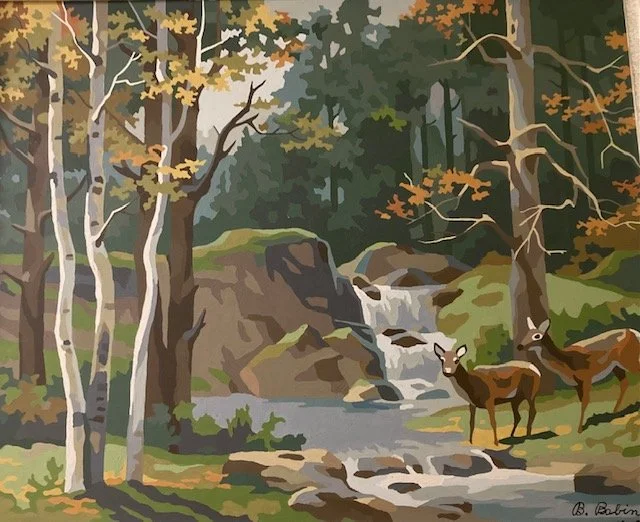
A Poem by Bill Keen
Once More?
I contemplate the bobber on the water. It is as still as a friend’s prayer at meeting. Connected to its moment by monofilament I sit as if I were asleep.
A gust of North wind roils the surface into ridges. In the furrow the bobber dances, dances, dropping its seed into the darkness perhaps to lure forth one more wish, one more harvest from the mystery before I lose the day’s last light.
As suddenly as the wind came upon me it dies. Placidity prevails, a perfect crust of ice on new fallen snow at dawn untouched by even an insect’s wing. My bobber is a still as a friend’s prayer.
Retrieve. . . retrieve . . . a small voice urges me, unfed need dueling with sense, to cast again, to cast again. But I am wearier than I thought and it is accident time, accident time. The uncast line is better, much better. There is something hungry in the water.
________________________________________________________________________________________
“I am William Parker Keen (Bill Keen), Professor Emeritus of English from Washington and Jefferson College in Washington, PA. During my graduate school days I spent two years at LSU (1959-1961)., learned to love gumbo, dark roast coffee, oyster po-boys, and zydeco music. I’m a dedicated reader of James Lee Burke’s novels. A couple of years back I visited the Bayou Teche.”
________________________________________________________________________________________
Issue #32.4 A Triple Issue: Jane Ann Fuller, Kate Efimochkina, Marco Visciolaccio
A Poem by Jane Ann Fuller
Houses
“The body is a temple, a house with many windows opening.” Mary P. at the Thursday meeting.
After you killed yourself, and after my house burned to the ground, I built this house with a bathroom window, wide and low, so I could watch the yard and soak it all in. I've tried to make sense of the wren’s attempts to please his mixed up mate with nests in half-dried ferns or in a birdhouse gourd painted cobalt blue. It spun in the breeze like a piñata, moss spilling out, dried shell of a life, once a belly packed with seed.
She enters and leaves so many times. She can’t choose. Or if she does, I never see the evidence. It’s like the world
can’t give more than it takes. How things must work to survive. The woodpecker wraps a long, sticky tongue around its own bright skull to keep its brains from spilling out,
then hammers shagbark hickories all the way up the trunk. I watch until it works on me like a therapy which doesn’t last. Late fall in the yard, the cosmos gone to seed, red and orange zinnias turned to sepia and gloom. Winter, another kind of dead
resurrection, the season that comes with church basement meetings, steps to work, black coffee, store-bought pinwheel cookies, prayer with strangers who say things I want to believe.
________________________________________________________________________________________
Jane Ann Fuller is a poet from southeastern Ohio whose book Half-Life (Sheila-Na-Gig Editions) was a finalist for the National Indie Excellence Awards. A Best of the Net nominee, Fuller is a recipient of the James Boatwright III Poetry Prize. You can find her poems in Anacapa Review, Bear Review, BODY, Calyx, Ekphrastic Review, Hunger Mountain, Main Street Rag, Shenandoah, and many other literary journals. Her new manuscript Darkened Window was a semi-finalist for the Washington Prize and is still looking for a home. Find more work at janeannfullerpoetry.com.
________________________________________________________________________________________
A Poem by Kate Efimochkina
Mother-of-pearl
Balconies, enveloped in mother-of-pearl. A vineyard and a cemetery across the river. Just one curve along the road. A wooden Jesus in the church. I looked at him until the priest quietly came out and stood behind me. He thought I was praying. But I was just watching, as I’d done a thousand times before. It was getting dark outside. It was early, very early spring with all its frenzy. The asphalt road, the trees ready to bud, the smell of dust heated by the day. Grinzing. I did not pay the fare. On my way back, I saw two people shaking a cigarette machine on a dark street.
________________________________________________________________________________________
Kate Efimochkina is a writer and artist. You can see her work in Stone Circle Review, Lamp Lit, The Turning Leaf Journal, among others. She is the founder and editor of Odd Lobster.
________________________________________________________________________________________

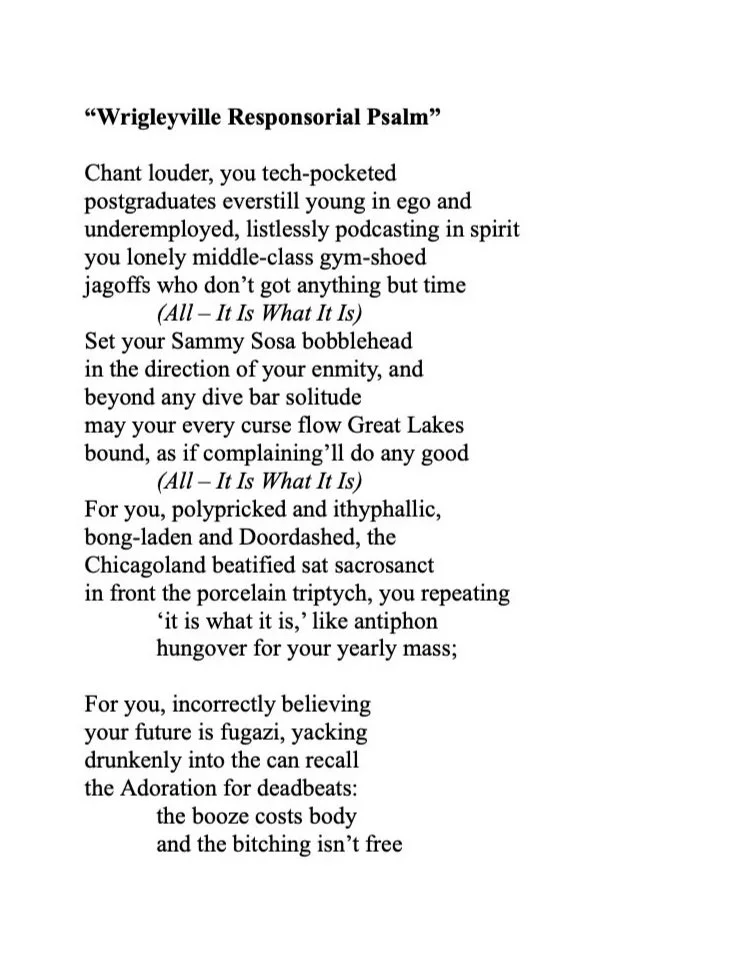
A Poem by Marco Visciolaccio
________________________________________________________________________________________
Marco Visciolaccio is an author in Asheville, North Carolina. He edits Flash Fiction for French Broads Lit, a publication celebrating authors in Southern Appalachia. His work can be found in Johnny America, Frazzled Lit, and elsewhere. He yearns for the unsolicited email. Site: visciolaccio.com
________________________________________________________________________________________
Issue #32.5 A Triple Issue: Kristy Money, John Grey, John Brantingham
Two Poems by Kristy Money
solar eclipse
moon over sun wind carries the vows their rings hidden behind rain celestial marriage
no polygamy in heaven for them or for me anymore I left that plane long ago
everyone hushes hill country caliche folding inside itself
Rosie's Baby Naming and Blessing Ceremony
I dared disobey twelve apostles
and a prophet
to hold you in my arms
with the wrong genitals.
My uterus carried you but birth’s the end of the line if you’re a Mormon mother.
After that we must watch while in church men do the
holding
withholding
exaltation
unless we submit
I’d rather hold
you
________________________________________________________________________________________
Dr. Kristy Money is a writer, university lecturer, and neuropsychologist in private practice. Her writing and interviews are published in The New York Times, Guardian, Salt Lake Tribune, Atlanta-Journal Constitution, and Exponent II, and forthcoming in Past Ten, Little Old Lady, Blood and Honey, and Eunoia Review. Her book, Overthinkers Guide to Orgasm, is currently on submission to publishers by agent Paige Sisley of CookeMcDermid. Find podcast interviews and more writing at kristymoney.com, on Instagram @drkristymoney, and on Bluesky @ofjacob.bsky.social. Kristy loves to write about the intersection of science, art, and spirituality.
________________________________________________________________________________________
A Poem by John Grey
Home from Brazil
I should have known the contrast would be too fierce. The winter I once knew has been replaced by something stranger, an alien landscape, dark in its ascendancy. Every window frames my reflection in frost. And the air, sharp, insistent, lashes at the tan I earned under a more forgiving sun, with a threat to fade it all away into transparency.
January bites down hard. Only the stereo has my back, sending out a warm-blooded samba that taps at my ankles, coaxing movement, reminding me of heat. My eyes insist on cold, but my ears, traitorous, tender, summon the ghost of a linen shirt lifting in a tropical breeze, and the soft, sure breath of a woman drawing a butterfly’s path from my ear to the nape of my neck.
I tell myself I need to relearn this climate, let it seep into my sleep, find a way to see past its indifference. Otherwise, my old routine will feel like exile. I must be stubborn, resist recent memories. I stack logs in the fireplaces. I smother the bed with blankets. I pretend that sufferance is a kind of wisdom.
But then there is Brazil. My head won’t let go even as my body shivers. A pandeiro cracks the air, a cavaco thrums, and a scatter of impossible birds takes flight behind my ribs. There’s no commanding yourself in moments like that. You dance, whether your body moves or not.
And that world. There’s no separation between man and what is out there. You’re either inside its pulse or watching from far away.
Right now, I’m watching.
________________________________________________________________________________________
John Grey is an Australian poet, US resident, recently published in New World Writing, River And South and The Alembic. Latest books, “Bittersweet”, “Subject Matters” and “Between Two Fires” are available through Amazon. Work upcoming in Rush, White Wall Review and Flights.
________________________________________________________________________________________
A Poem by John Brantingham
________________________________________________________________________________________
The late John Brantingham was a New York State Council on the Arts Grant Recipient for 2024, and he was Sequoia and Kings Canyon National Parks’ first poet laureate. His work was published in hundreds of magazines and The Best Small Fictions 2016 and 2022. He wrote twenty-three books of poetry, nonfiction, and fiction. https://www.johnbrantingham.com/
________________________________________________________________________________________
Issue #32.6 A Triple Issue: Margie Banker, Karina Longo, Darby Myr
A Poem by Margie Banker
reclusion(s)
They want me for my body, this flesh and bone and skin, for their desires only, for the sins of their fathers, for the anger towards their mothers. They bend me, over beds, over backwards, to quench their thirst. I never hear their voice again, not aloud or in my head, fade into the depths with the others, skeletons of my own creation–see, this is why I do not touch my own skin, for fear of the recoil, the backlash, the hideous inside-turned-out. I am not built to withstand the weight of desire, would rather become, like a recluse, the spider in a dark corner, poison that eats away at your skin,
the one no one knows or fears but should.
________________________________________________________________________________________
Margie Banker (they/them) is a dyke poet born and raised in the Upper Midwest. Confessional by nature, Margie writes to survive. Margie holds a BA in Women's, Gender, and Sexuality Studies from Macalester College. They're currently pursuing their Master's in Creative Writing while working in administration at a small liberal arts school. Their work has been featured in Boshemia Magazine, Issue 7. They have too many animals for their studio apartment, and have rocked a bowl cut for well over a decade.
________________________________________________________________________________________
A Poem by Karina Longo
________________________________________________________________________________________
Karina Longo is a neurodivergent Brazilian-Italian poet. She's the editor-in-chief of La Rotonde Review, and her poetry has been featured or is forthcoming in Expat Press, Be About It Press, Eunoia Review, Apocalypse Confidential, Some Words, Dodo Eraser, Michigan City Review of Books, and other places. Find her on X: @TheDarkestStar
________________________________________________________________________________________
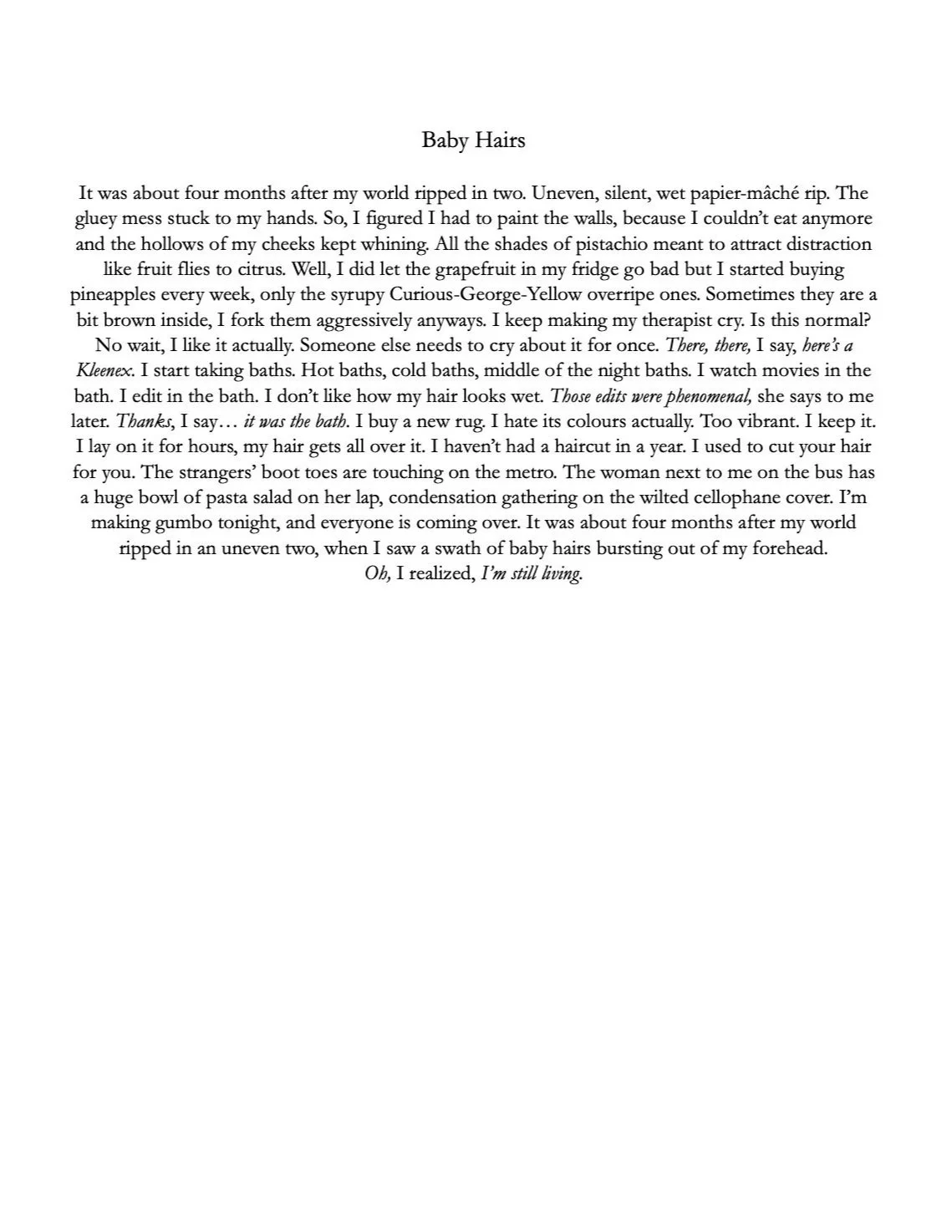
A Poem by Darby Myr
________________________________________________________________________________________
Darby Myr is a queer writer, textile artist, trained anthropologist and tree planter. Her work is forthcoming in SQUID literary, Raiya Magazine and Qu literary. She is based out of Montreal when she is not stuck in the teeth of the northern Rockies.
________________________________________________________________________________________
Issue #32.7 A Double Issue: Nikki Ummel and Paige Stephens
Three Poems by Nikki Ummel
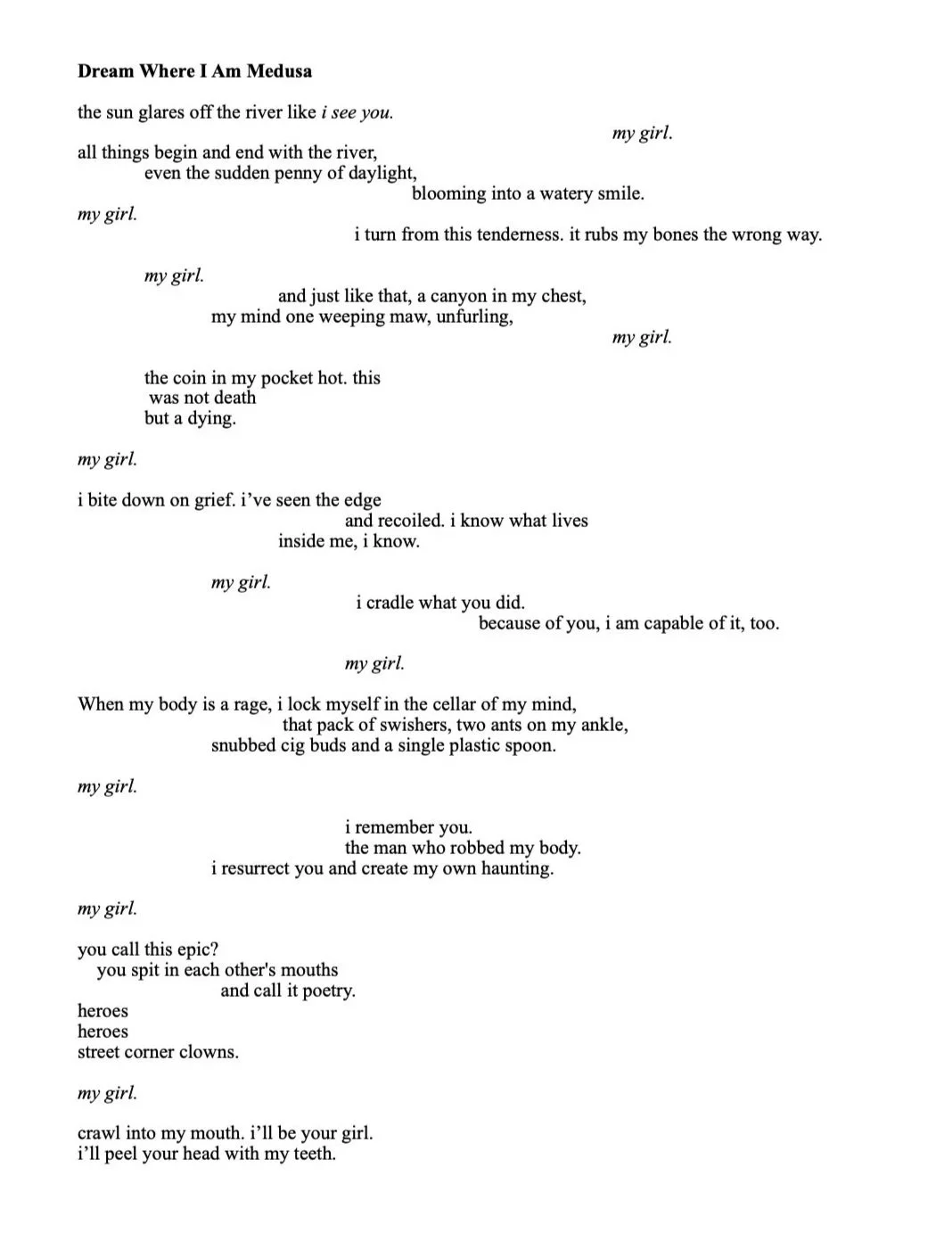
Dream Where I Am Nana, the Mother of Attis
after reading Catallus’ 63
I bit through the stick of willow’s bark. You were quiet (so quiet, I thought my prayers answered). But the crying came, and you, blue, eyes wide and skin slick: a protest. Attis, I did not ask for this. I did not ask to nurse you or watch you seed the world.
I heard my father scour the field, he called me and I left you, splayed on almond husks afterbirth-sticky, left you shell-shrouded in swaddled silence, to seek my father, to hold his hand in the dying light, too dim to see my spurned milk bloom, my choice, this poem, my own.
long day
cotton tongued & cheeks clawed, i am trapped in terminal restlessness / its clanging cymbals. this body a living current / my meds popping buttons to keep the electricity contained. lamictal comes dragging her rope / scorches my fields. where are my brave? my cousin texts me from jail, says he can’t sleep / demands, am i a ghost? then tells me i am not real. two different words in my mouth: living / alive. time is a puddle in my hands. i keep living because i don’t know what else to do.
________________________________________________________________________________________
Nikki Ummel is a queer artist, editor, and educator in New Orleans. She has been published or has work forthcoming with Gulf Coast, The Georgia Review, Texas Review Press, Black Lawrence Press, and others. Her debut poetry collection, Swamp Elegies, is the 2025 winner of the New American Poetry Award and will be published in late 2026. Nikki is the Executive Director and co-founder of LMNL, an arts organization focused on providing free and accessible workshops, readings, community events, and more. She has two poetry chapbooks, Hush (Belle Point Press, 2022) and Bayou Sonata (NOJHF, 2023), funded by the New Orleans Jazz and Heritage Foundation. You can find her on the web at www.nikkiummel.com
________________________________________________________________________________________
A Poem by Paige Stephens
Check the Trash Can for a Condom
My sister can’t get pregnant. She never started bleeding, and she can’t get cramps like I do. I think about this as I slide out of his bed, stalling to remember where I left my things. I tiptoe to his bathroom and check the trash can for a condom. My skin feels wrong. Like there were sand grains in my sunscreen and somebody made me rub it in anyway. They’ll all be able to tell—that I’ve added another tick mark to the mirror in my bathroom.
***
He grumbles something in my general direction when I walk back into the bedroom. He calls me Brittany. And I don’t even look like a Brittany. A Brittany would have blonde hair and cherry-colored little lips and would never wear toe socks with flip-flops. I grab my shoes and leave without bothering to slip them on.
***
As little girls, my sister and I played husband and wife. We took turns taking care of the baby, washing the dishes, doing the laundry—pretending the future was something you could rehearse. Now she lives in a cute cottage with her understanding husband, Rick. They have a garden and flower boxes under their windows. I rent a run-down townhome from a sketchy real estate company that fixes things only when they’re already broken. I don’t live with my mother. She lives with me—downstairs, in the room that used to be my office.
***
She pretends that when I come home early in the morning it’s because I’ve been out getting coffee or sitting on the patio talking to a friend. But she knows. She knows I’m going to stand in my bathroom with lipstick and do math with my body. She thinks she counts my birth control pills every week, secretly. She says it like it’s concern, like it’s love: I just don’t want any illegitimate grandchildren. But I see her sitting at the tiny breakfast nook, helping herself to the intimacies of my life. I guess that’s why she moved in with me—because I’m the daughter who might get pregnant.
***
I’ve only had one real relationship. He was handsome, but not in the prince charming kind of way. He had a nice face and broad shoulders, but he wore wife beaters and flat-billed baseball caps and called himself a poet. He didn’t want his work read—only said out loud to music. I called him a rapper. We argued about that a lot. He changed his name often to give himself “character,” like Eminem. He was BJ when I met him, and by the time we broke up he had evolved into Zenzo. My friends used to tell me stories about him after it ended. Now, even if someone tried, I wouldn’t know who they were talking about. He’s probably changed his name again.
***
After my shower, I stand in front of the mirror and study the tick marks—lipstick, bright as a bruise—like they’re proof and not a plea. Fourteen. I always thought a man wouldn’t notice. That he wouldn’t know what he was adding to.
***
The next one will be a long tick mark—one that goes across the whole line.
Not a tally.
A sentence.
________________________________________________________________________________________
Paige Stephens is a writer and middle school teacher from South Mississippi. She writes flash fiction and poetry with Southern bones—voice-driven work that leans tender, sharp, and occasionally sideways.
________________________________________________________________________________________
Issue #32.8 A Triple Issue: Nancy Byrne Iannucci, Isabel Chenot, Harold Bowes
A Poem by Nancy Byrne Iannucci
Wuthering Heights Sounds Like Spring to Me
My mother took me back to England
to say goodbye to my aunt, who was moving to Australia.
I remember spending days preparing for her party.
I can still hear my mother and her sisters laughing like witches
in the front parlor of my grandparents’ house,
cutting square cucumber sandwiches and shelling hard-boiled eggs,
with the windblown daffodils knocking the crown glass panes
like a bouquet of restless Cathy’s.
Top of the Pops was on TV as white noise until I heard her,
a banshee in a black dress, yowling:
Wuthering, Wuthering, Wuthering Heeeeiiights, Heathcliff…
her eyes wide, moving side to side, seeing things only a cat could see.
I wanted to know more about Wuthering Heights and this woman singing it.
I was only six, going on seven. My aunts pulled the novel from the bookcase and held it high
like a Book of Shadows. Haworth, they said, is too far from where we are in Birmingham.
My grandmother, sensing my disappointment, took me by the hand
and walked me to the record shop where she purchased my first 45:
Kate Bush’s Wuthering Heights.
We passed the silly daffodils on the way back,
but it was the rolling, grassy hills that called me, and I hummed back,
out on the wily, windy moors we’d roll and fall in green,
forever imprinting the sound of springtime
and the softness of my grandmother’s hand.
________________________________________________________________________________________
Nancy Byrne Iannucci is a writer from New York —her work has appeared in Thrush Poetry Journal, Belladonna's Garden Literary Magazine, Eunoia, 34 Orchard, Maudlin House, Gnome and Bone, and San Pedro River Review. She is the author of four chapbooks and is a two-time Best of the Net nominee. She was also short-listed for the 2025 Poetry Lighthouse poetry prize. When she is not writing, she's roaming the fields near her home in upstate NY or playing with her three cats: Nash, Emily Dickinson, and Rocky -- Web: www.nancybyrneiannucci.com Instagram: @nancybyrneiannucci
________________________________________________________________________________________
Two Poems by Isabel Chenot
Cruciferae (i)
Spun on a planet's loom and highbeams of a car, moths wear away a star.
The dry roads bloom with dust, the fieldmotes spiraling on dark. Then, boom:
it all combusts, is nebular, erupting. Mothwing
dust and vacuum argue what we are to weeds.
Nothing then sunbeads, sudden spars. Summers that blind and sear
remembering. The ardent mind engendering. Wild, detonating seeds.
Cruciferae (ii)
(for P. J. P.)
Almost there, shielding my sight, I stopped the car and nearly kneeled where a seed-spewn, naked light bore the cross beside a field.
In that glare, my hand a shield, the beams flowering where they might, I half-knelt. Someone else tilled and nailed my hand at calyx-height.
Soon I’ll carry it as slight, the lordweight, as the dust can yield. I’m learning to be other-willed. Call me a weed’s acolyte.
________________________________________________________________________________________
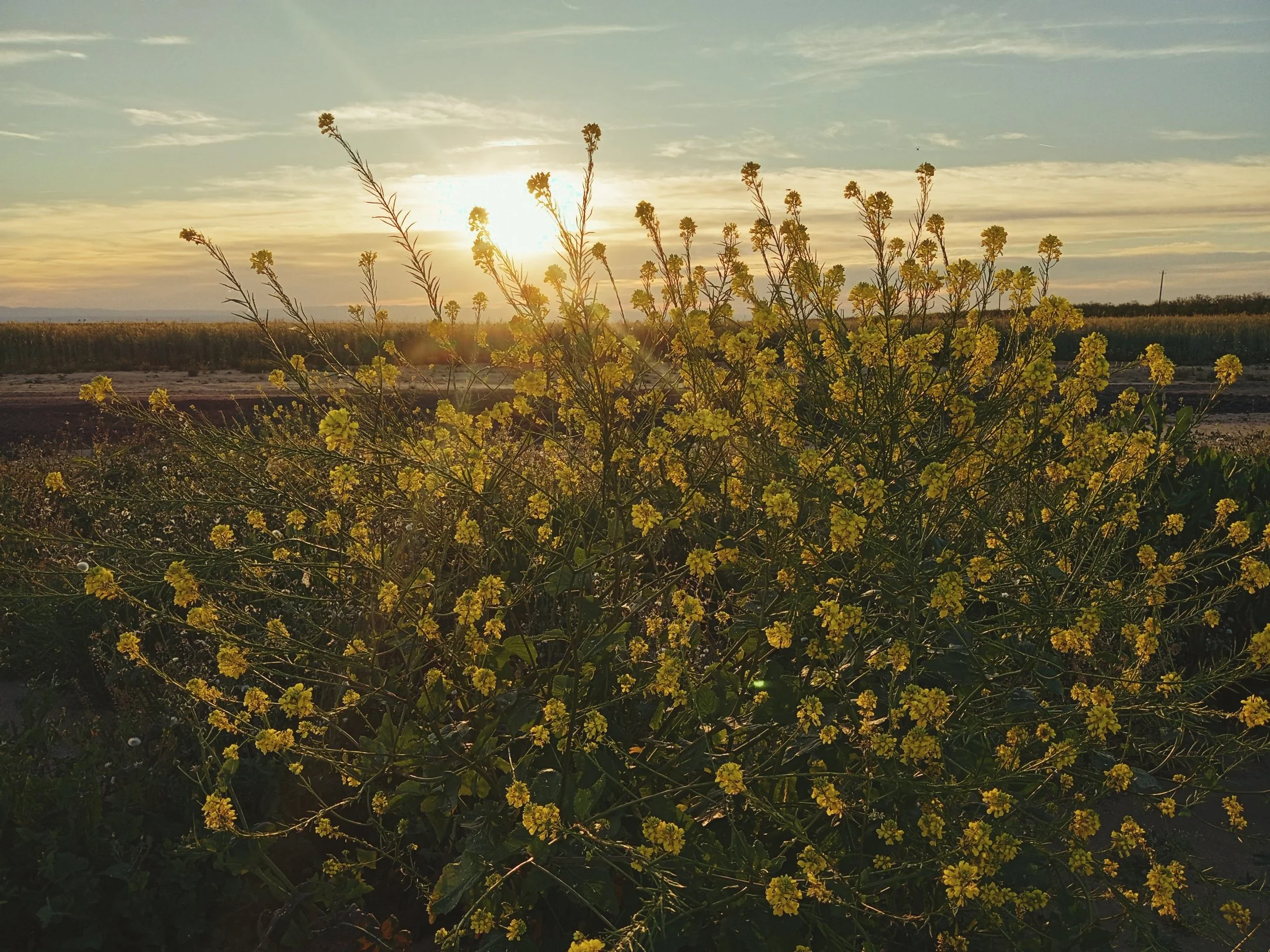
Isabel Chenot has loved, memorised, and practised poetry all her remembered life. Some of her poems are collected in The Joseph Tree, available from Wiseblood books. "Cruciferae", "cross-bearing", is the older Latin name for mustard, descriptive of its cruciform flowering. Cruciferae (ii) is structured to imitate repeating four-petaled florets.
________________________________________________________________________________________
A Poem by Harold Bowes
Jasper the Year after the Fire
We wake up with the sunrise, at Jasper Park Lodge, On the shore of Beauvert Lake, and see an Elk has wandered Through the drifting mist and into the cabin’s front yard,
— ∪ ∪ | — ∪ ∪ | — ∪ ∪ | — ∪ ∪ | — ∪ ∪ | — x
As startling and satisfying as when I discovered The plus sign in the top right corner of my iPad Opened another window, and another
— ∪ ∪ | — ∪ ∪ | — ∪ ∪ | — ∪ ∪ | — ∪ ∪ | — x
On the train over from Vancouver, we ate in the dining car With stainless steel cutlery, on white tablecloths Snow covered scree, in a meadow, deep in a ravine
The slogan on my baseball cap says: “Tax Wealth, Not Work”
I hear my wife and daughter talking in the next room About my driving skills, and how much they love each other, And I’m getting into the shower as we prepare to drive the
Icefields Parkway
The lake shores here go round, one half black stumps, The other half green; 180 degrees of life, 180 of death, Symbolic and liminal as it gets
I’m a burnt-out tree truck, my daughter a green shoot
On the trail around Beauvert Lake a sign describes the species of tree: Douglas fir, lodgepole pine, white spruce, and trembling aspen One burnt-out trunk looks like another burnt-out trunk, but that trembling,
That trembling
I mention to my daughter how I always forget place names after I get home But that “Beauvert” ends in “vert” and I will remember “Vert” because There is a performance venue in our home town with that name
The lake is a beautiful thing
And “beau” is easy, right! Then I had to look up the name of the lake When I got home because I had forgot the first part. “Beau”! The bowling alley at our tribal casino is named “Quaking Aspen”
Icefields Parkway is easy too, but I remembered it singular: “Icefield”
It is radio silence on the Parkway and we don’t have any good downloads I start singing to the captive audience in the car but I can’t Remember the lyrics or maybe only the chorus sometimes
I sing the one line I remember
When we get to Lake Louise, we take photographs, then turn back Returning over the Parkway, stopping at the glacier, we’re thinking that At the lodge there is one heated swimming pool,
— ∪ ∪ | — ∪ ∪ | — ∪ ∪ | — ∪ ∪ | — ∪ ∪ | — x
And one sauna, and one steam room, per gender, in among All the lakes that seemed to be named after favorite aunts (Mina, Majorie!) And 12 snow-covered peaks circling a valley
— ∪ ∪ | — ∪ ∪ | — ∪ ∪ | — ∪ ∪ | — ∪ ∪ | — x
Starting out from an old boathouse on another Lake the next day, We see an ice shelf reaches halfway to the other side, The ice breaking into wedges near the shoreline,
— ∪ ∪ | — ∪ ∪ | — ∪ ∪ | — ∪ ∪ | — ∪ ∪ | — x
The shards tumbling against each other in the waves Make a sound like God’s windchimes, or God’s bowling pins, While beyond the ice sheet the water is white capping
Snowcapped peaks arc the lake, going nearly 180 degrees around
In WWII, the Canadians built an ice ship on Lake Patricia, A prototype aircraft carrier, reinforced with wood pulp The sunken metal parts remain there, under the surface
The next lake over is called Pyramid Lake
Returning to Vancouver in the train, an overnight trip, The cars sheathed in stainless steel feel airtight And I wake at 2 am in my bunk with an anxiety attack
— ∪ ∪ | — ∪ ∪ | — ∪ ∪ | — ∪ ∪ | — ∪ ∪ | — x
Gripping the iPad, I stumble up to the Skyline car, There is no one there and I am on a precipice about to fall I hold onto a seat and watch the red signal lights
Appearing at gradually reassuring measured intervals
________________________________________________________________________________________
Harold Bowes is the author of Detached Palace Garden (Ravenna Press, 2017). Harold’s poems have appeared in elimae, THRUSH Poetry Journal, alice blue, SOFTBLOW, Portland Review, DMQ Review, failbetter, and many others.
________________________________________________________________________________________
Issue #32.9 Ruth Bavetta, Bud Sturguess, Ted Lardner, Mykyta Ryzhykh
A Poem by Ruth Bavetta
Taxes, Tenacity, Tigers and Toast
I used to love to jewel in the yard, even when I was taking care of my guitar
and both rabbits, plus recycling the ducklings until they were too wet to tuck in bed,
so when I hired the possum I thought I’d just let him play some
in the pond in the park, but all the picnicking was only nitpicking. Trouble is,
when you’re not at the bakery every day and bad paintings never get to say a word
and gradually things carport up on you. Beefburger, hamburger, cardigan, cantaloupe.
________________________________________________________________________________________
Ruth Bavetta’s poems have appeared in North American Review, Nimrod, Rattle, Slant, Atlanta Review, Tar River Poetry, Silver Birch and many other journals and anthologies. Her published books are Fugitive Pigments, What’s Left Over, Embers on the Stairs, Selected Poems, and Flour, Water, Salt. She likes the light on November afternoons, the music of Stravinsky, the smell of the ocean. She hates pretense, prejudice, and sauerkraut.
________________________________________________________________________________________
A Poem by Bud Sturguess
Worse Than Angler Fish
“Don't do it,” I said to the Creator my eyes wide with indignant virtue “They're going to do awful things down there Rotten, ugly, awful things And they'll put it on the internet to make it never matter.”
The Creator's face hovered over the chaos before we called it that and said, “Let there be light.”
“They'll snuff it out in a week,” I said “They'll write DARKNESS on their walls and will it into being.”
The Creator said, “Let there be a firmament.”
If I didn't know better I'd have thought He was ignoring me But I knew better
Then came the land and the grass The same they're going to use to dig big holes to put their trash and nuclear waste (and call it “nucular” waste) Then the stars and the light and rocks in the sky the ones they'll end up worshiping (Like I told Him, “they'll always prefer creation over Creator.”)
Then came the birds and the creepy-crawlies unnecessary and gross Things like scorpions and angler fish things I think He made from somebody's nightmares
And despite my most vehement, strident, fervent, vocal objections, the Creator made man, the worst of all worse than angler fish The ones who'll put holes in the earth and stain the firmament a sickly yellow “They'll take all those green things You're so proud of,” I said “and use them to lobotomize themselves Then they'll invent lobotomies.
“They're going to bicker about calling themselves man They'll invent the grossest words You've ever heard They're going to kill each other They're going to do whippets And the worst of all suppose someday the sinners are allowed to take their sinnings back.”
Nobody listened to me My two cents weren't fit to buy sparrows The Creator created it all anyway and the heavenly host didn't raise a hand They're just like sheep
Just as I foretold the whippet-loving ghouls set up altars to blobs and oxen They're digging up the places where some of the Creator's best stories were told to find slime and rocks to kill each other and just like I said they would they record every burst with funny captions and Jojo Siwa playing over it to lighten the mood that didn't have to exist
The gaggles of the giggly idiots He allows to wander about paint portraits of not only the smoking craters they live in, but the ones who make them They even give their eyes a sick kind of light And for every Nietzsche there's another like him who up and takes his Nietzsche back
And here on my lofty perch, where I watch doomsday after doomsday the terrible, radiant angels who surround me hear their grumbling and whisper to the biggest grumblers how they should write a billion songs about it
________________________________________________________________________________________
Bud Sturguess is a writer living in Amarillo, Texas. His work has appeared in Longleaf Review, Ekstasis, and New Pop Lit. He has self-published several books via lulu.com, his latest being the novel Things Blowing Up.
________________________________________________________________________________________
A Poem by Ted Lardner
Two Bottles of Wine
Two young people split off from the others down there, where the Navarro River empties into Navarro Bay, skirting the tidal flat beyond the campground 500 feet below the Highway 1 bridge. Look at the tents, all the RVs and campers parked side by side. Some of the big RVs have satellite dishes mounted on their roofs and the satellite dishes are all pointed in the same direction, which is towards some clouds or maybe the moon, or something else you can’t see.
The young people are from the group of young people from the store, back up the road at Harvest Market in Mendocino, where you come in the door counting ravens on the church and walk backwards slow and long enough along an aisle of olive oil and crackers until you arrive at a summer when you turned 18. If you could listen as deeply as a satellite dish can, you could probably hear them now, those young people, how expertly they whisper,
twisting, as they speak each other into their futures, the little metal key around, building up on its tip the thin strip, peeled of metal, corner to corner, around the edges of the lids of those navy blue tins of sardines, while all the while, deep offshore, the accompanying movement of those great schools of silver fish swimming.
________________________________________________________________________________________
Ted Lardner’s (he / him) nonfiction and poetry have recently appeared in Post Road, Light Enters the Grove, The Watershed Journal, and Bristlecone Magazine. He is the author of three chapbooks, Passing By a Home Place (Leaping Mountain Press 1987), Tornado (Wick Poetry Center / Kent State UP 2008), and We Practice for It (Sunken Garden / Tupelo 2014). An avid native-plants gardener and a part-time yoga instructor, Ted lives in northeast Ohio.
________________________________________________________________________________________
A Poem by Mykyta Ryzhykh
Love
1
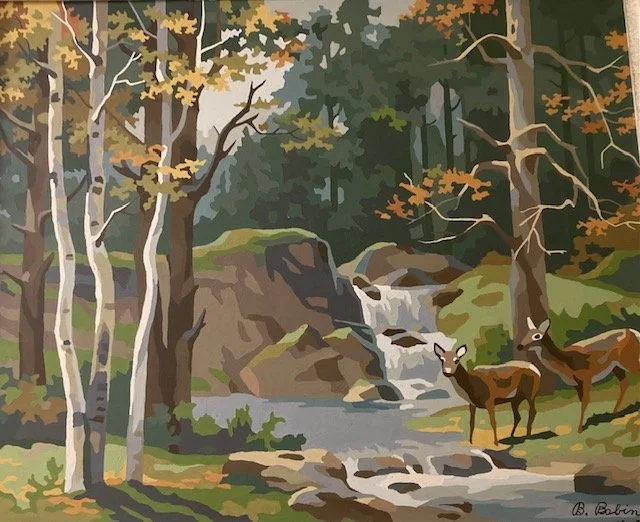
to love you like a magnolia
to love you more than a magnolia
to love you instead of a magnolia
2
on both shores only you
but i am not a ship not a sea and
no longer a man
3
yes you are magnolia
float away
________________________________________________________________________________________
Mykyta Ryzhykh, an author from Ukraine, now lives in Tromsø, Norway. He was nominated for a Pushcart Prize in 2023 and 2024. He’s published in many literary magazines іn Ukrainian and English: Tipton Poetry Journal, Stone Poetry Journal, Neologism Poetry Journal, Shot Glass Journal, QLRS, The Crank, Chronogram, The Antonym, Monterey Poetry Review, Five Fleas Itchy Poetry and many others.
________________________________________________________________________________________
Issue #32.10 Cody Adams, John Dorsey, Sam Rasnake
A Poem by Cody Adams
Before My Grandpa Died This Morning
he shot a fat buck in his backwoods,
left a trail of pink snow toward
the barn. He bound its hooves and hoisted
them up on a hook so the antlers scribbled
softly on the dirt floor. I glimpsed my reflection
in Grandpa’s hunting knife as it slid silently
from groin, through gut, to throat. With bright
red hands, he emptied its innards until
they were a glossy pile steaming on the
frozen Earth. He smeared war paint beneath
each eye like an ancient linebacker, then rubbed
the rest above the barn door. He turned
to me before he left and said,
“Be good.”
________________________________________________________________________________________
Originally from Buffalo, NY, Cody Adams currently teaches literature in Toronto, ON. His recent work has appeared in Solum Literary Press, Heart of Flesh, Defenestration, Ekstasis Magazine, Cacti Fur, Appalachia Bare, among others. He received his B.A. degree from St. John Fisher University and his M.S. degree from the University of Rochester. He also serves as a Board Member for Forefront Festival.
________________________________________________________________________________________
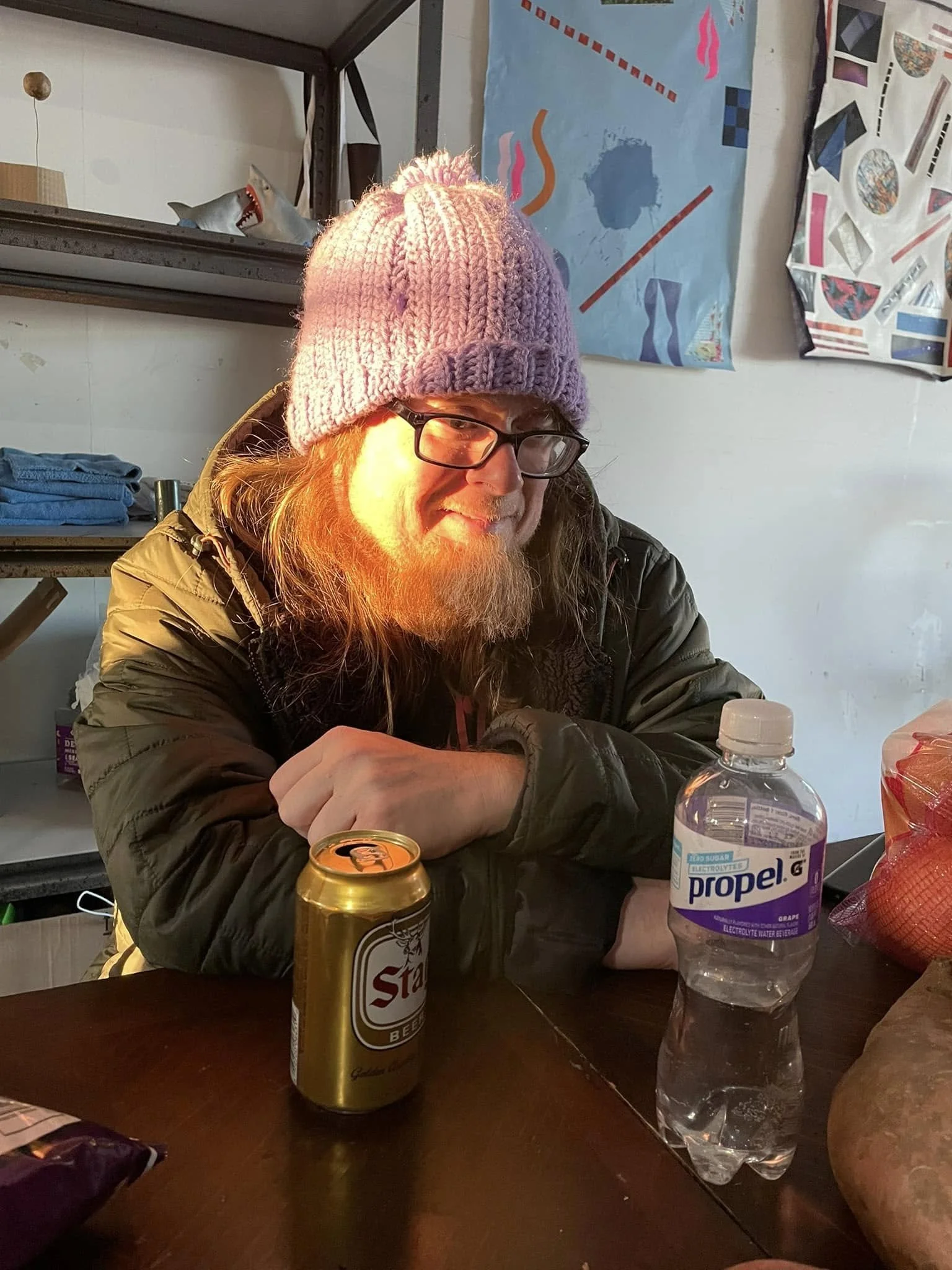
Two Poems by John Dorsey
Obituary Song
for s.a. griffin
we talk on the phone about all of the old friends who’ve passed since the last time we talked & those who simply disappeared in a cloud smoke & gunfire
those on walkers & the soon to be ghosts getting stoned just to get by in this country of open caskets & closeted dreams
neither of us have ever slept well both of us up with the sun just waiting for old angel midnight to flip the switch.
Imagine
the city vanishing before noon a bus station in toledo now lost to mythology at the family dinner table the dead light overflowing with morning air a new war closer to home.
________________________________________________________________________________________
John Dorsey is the former Poet Laureate of Belle, MO. He is the author of several collections of poetry, including Which Way to the River: Selected Poems: 2016-2020 (OAC Books, 2020), Sundown at the Redneck Carnival, (Spartan Press, 2022, Pocatello Wildflower, (Crisis Chronicles Press, 2023) and Dead Photographs, (Stubborn Mule Press, 2024). He may be reached at archerevans@yahoo.com.
________________________________________________________________________________________
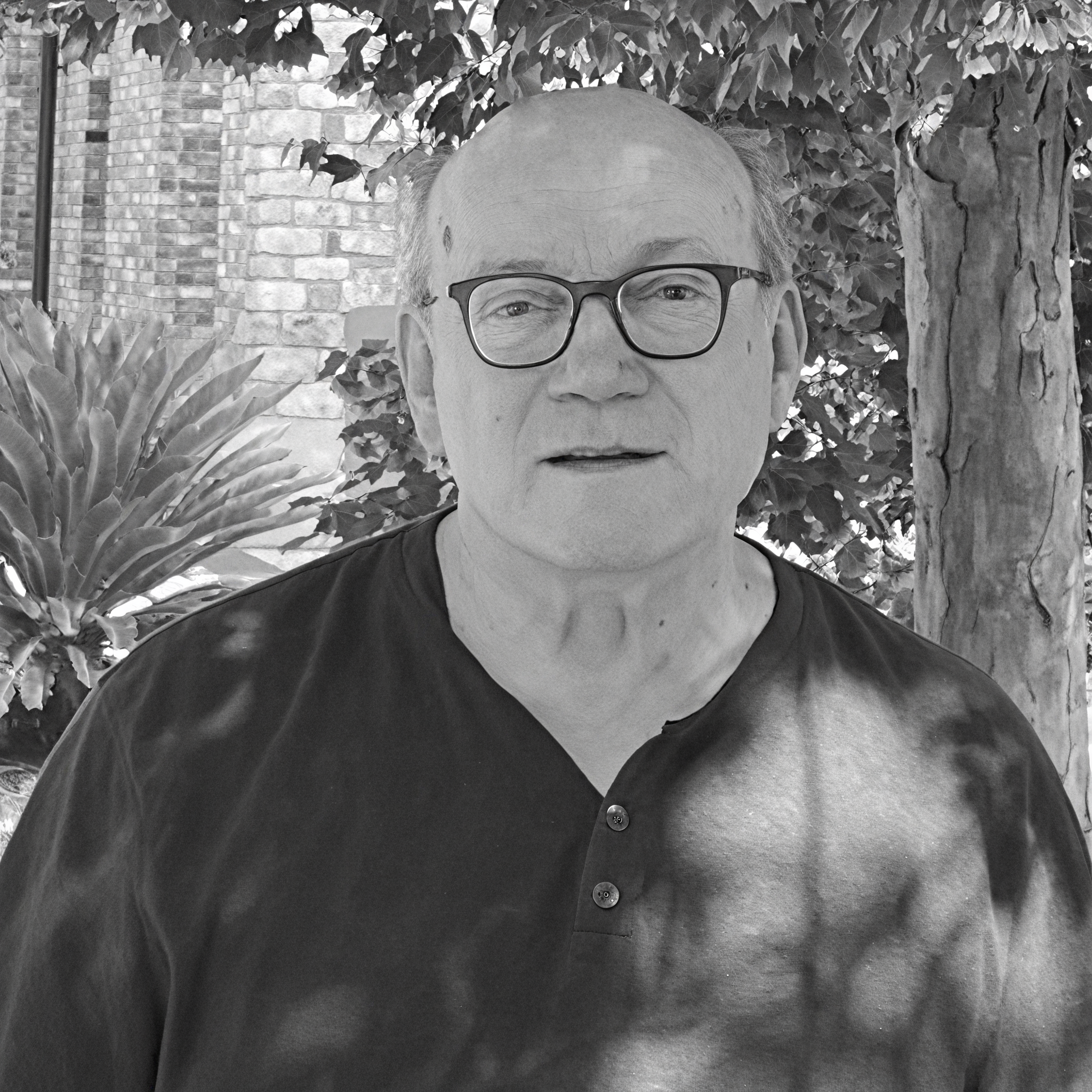
A Poem by Sam Rasnake
Poet at Home, Shares Reflection
after Barnali Ray Shukla
What we see in the night is never what is but is real enough to hold us before the glass while the city sleeps. A dull wind is moving
beyond the window, threading into the dark. We can see flutterings of shadows and tremors of lights along the blurred edges of view.
None of this prepares us for a life with no moon. The stars are free but lost to the sweep of low, thick clouds and the rains that must follow.
The river, palm, and lotus wait for the may-awe of the peacock’s throat, for the beautiful chaos, for lush hillsides, for a life no longer on pause.
________________________________________________________________________________________
Sam Rasnake’s works, nominated multiple times for the Pushcart Prize and Best of the Net, have appeared in numerous journals and anthologies including Best Small Fictions, Best of the Web, Southern Poetry Anthology, A Cluster of Lights, Bending Genres Anthology, and MiPOesias Companion. He was chapbook editor for Sow’s Ear Press (1992-2022), was a member of the inaugural 2023 Kari Ann Flickinger Memorial Literary Prize Adjudication Panel with Ballerini Book Press, has served as a judge for the Dorothy Sargent Rosenberg Poetry Prize, University of California, Berkeley, and was an editor of Blue Fifth Review (2001-2018). He’s the author of three chapbooks and four poetry collections—most recently, Fallen Leaves (Ballerini Book Press, 2025).
________________________________________________________________________________________
Issue #32.11 Linlang Zhao, J-T Kelly, G. Sabbatini
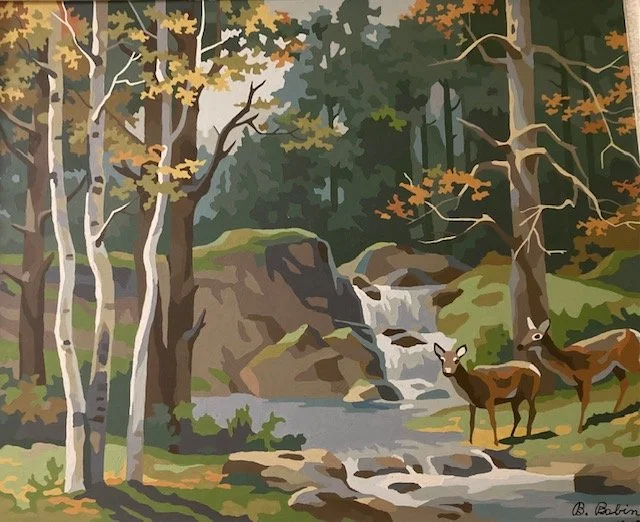
A Poem by Linlang Zhao
Thunder of Nights
It was years ago beneath the noon light, under the kind of melting air sticking under the sun, where something like water moved between my father and me.
He stood there, pointing at the architecture in red and black, drifting like another hill the river never reaches in that dusty county we called ours.
It felt like foam without the sea, or a lucid summer light where morning mist thins before it settles, as if the air erased the outline
of my lungs in the heat. I kept wondering why the county shifted like waves without ever holding water—
how brutalist buildings cinched themselves inward, how wheat practiced folding into its own shade.
It’s that distance between us and rain: Gutters bleached to bones, smog worn like an artificial scarf. Summer passed without breaking open the sky;
we named clouds but never followed them, as thousands of them loosened their shape What stayed was dust settling into our knees, when time walks through the ridge, dripping in the forty-degree.
I left carrying a dry season sewn into my pockets. The train loosened the county from the skeleton of my name. It must be a miswilled fortune, when the rain forgot me and then
decided to compensate: it keeps finding me in Guangzhou: on borrowed streets, on rented windows, soaking up the language I speak now. The south opens its palms. I stand there, almost leaking, as water presses against the glass
and waits.
The river pauses before touching us. Childhood stays where rain never arrives, where departure is the only season that moves. Now I keep wondering how to pour the ridge’s water back into my hand. Across treasure and treasured, into the unforeseen raindrops. Night gathers without thunder, evolving to veil that county across the span of years. I’ve attempted to peek inside there once, but it’s never raining, nor entirely dry.
________________________________________________________________________________________
Linlang Zhao loves eating and cooking. She enjoys messing with her cats as well. Her work can be found at Midway Journal, Sierra Nevada Review, Tap into Poetry, Cetera Magazine, and others. You can find her at @thisissobad1.
________________________________________________________________________________________
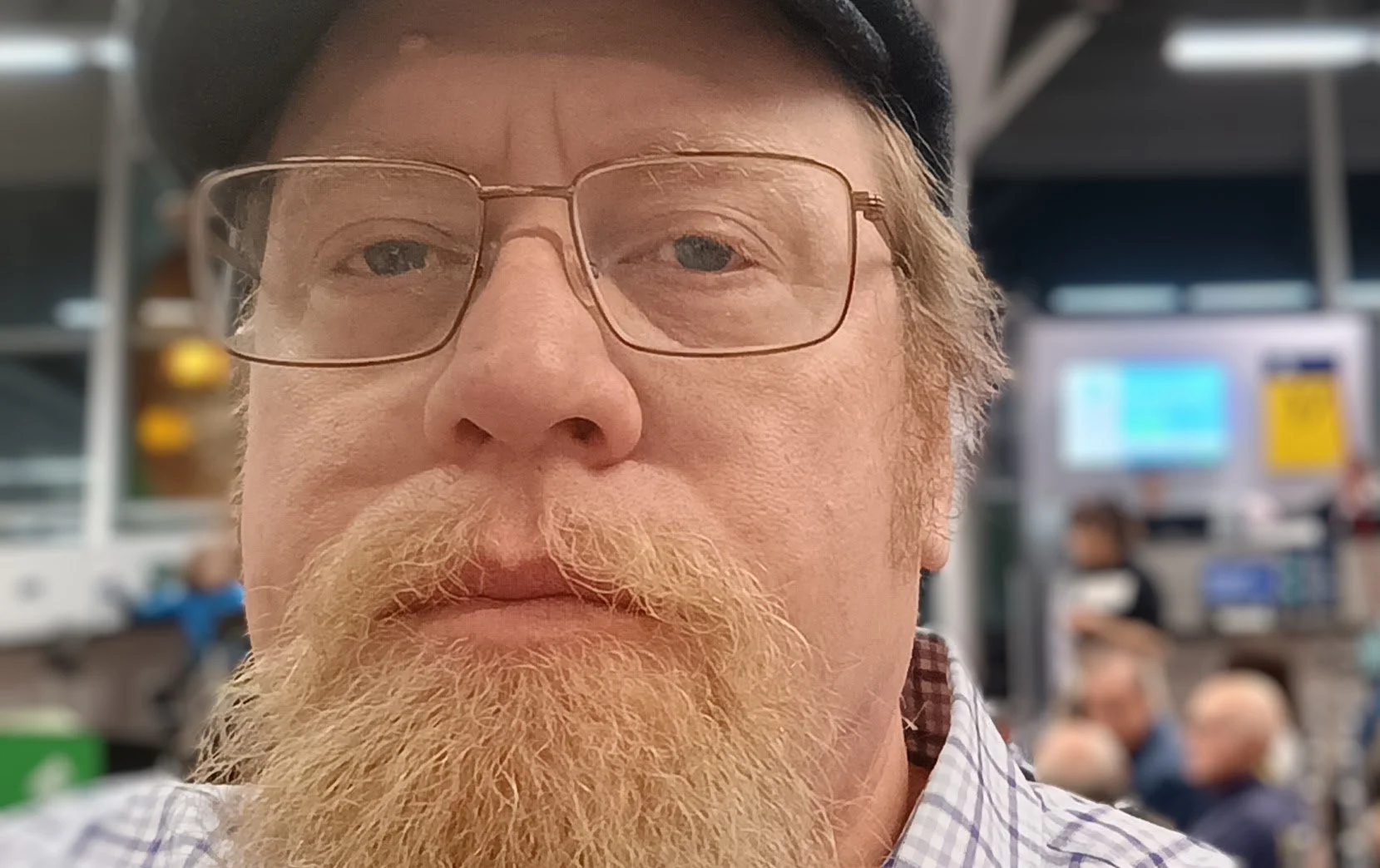
A Poem by J-T Kelly
Untitled [In my simple world...]
In my simple world—and this is logistics—here is where I learned laundry and composting, and there is Ryan slipping into the river after drinking alone, leaving everyone feeling guilty about feeling relieved. Things accumulate after a tragedy. Plastic, mainly. But Pete did have to get a tetanus shot—in his stomach if you can believe!—so you know there’s some metal down there, just like you know there’s something bad down there. You can feel things change around you when you get close to the place where the water goes underground. Once you’ve been there it’s always with you. You can close your eyes and follow the river into the dark opening and past the cold metal grate, down under the highway and the new hospital, and up out of the city. But before it gets to the swamp, it passes directly under the Cincinnati Museum of Children’s Book Illustrations, where you can—and this is more complicated than it sounds—stand in this corner here and whisper, and be heard clear as a bell in an alcove on the other side of the courtyard, way over there.
________________________________________________________________________________________
J-T Kelly works in real estate in Indianapolis. Poems in The Denver Quarterly, the nu review, Bad Lilies, and elsewhere. Chapbooks: Like Now (CCCP/Subpress, 2023) and More of How to Read the Bible (above/ground, 2025).
________________________________________________________________________________________
A Poem by G. Sabbatini
Centuripe’s Daughter
No one prepares you for how you will feel when you encounter your blood in the archives. No one prepares you for how you will feel when you realize how suffocated you’ve been by the reductive hellenistic haze that has, for some years now, made it impossible to recognize your ancestor for who she really was. No one prepares you for how you will feel when you come to terms with the fact that we will never know how she died, or if her brothers were killed in the war with Carthage, or if her mother prayed to Hybla, or what she thought of the stories told of tyrant Agathocles. No one prepares you for how you will feel when you are conscripted into her service: that militarized parlance you adopt in an attempt to validate your quasi-academic obsession with a single terracotta funerary shield that has been banished to a back corner of your campus’s wannabe-encyclopedic antiquities hall. No one prepares you for how you will feel when you decide to rationalize your compulsive pacing in front of her (back-and-forth-and-near-and-far, repeat, repeat again) as a necessary precondition for creativity. No one prepares you for how you will feel when you realize that the truths you tell about your intense desire for a family history made whole are, some days, days like today, little more than a mask for the lies you tell about your OCD. No one prepares you for how you will feel encountering this artifact, of all places, five thousand odd miles from its point of origin in the middle of a corn-fed college town that has never been nor ever will be your home, despite the lie your driver’s license tells. No one prepares you for how you will feel when your treading (back-and-forth-and-near-and-far, repeat, repeat again) is called out by a crowd of middle-school visitors whose Nikes squeak as they prance between installments, never taking note of the girl whose flesh was painted onto clay as seemingly fragile as she. No one prepares you for how you will feel when you realize that the family history that has been passed down to you in murmurs has gone quiet. No one prepares you for how you will feel as you punish yourself unnecessarily for the curse of being an American who resembles your immigrant grandparents physically but not linguistically. No one prepares you for how you will feel when your sense of self becomes collateral damage in a homecoming you’re told you aren’t allowed to have because you were born here, not there. No one prepares you for how you will feel when you stand before her, desperate to quiet the clichéd echoes of Kennedy’s— no, Palmerston’s, no Cicero’s—exceptionalism: Civis Romanus sum. No one prepares you for how you will feel when you stand before her, paralyzed at last in a final act of supplication to Centuripe’s daughter—Sicilian, Roman, Greek—wanting nothing more than to be recognized as hers.
________________________________________________________________________________________
G. Sabbatini writes poetry and fiction that investigate creative mythologies and cultural memory. Her work explores the stories we tell about art, artists, and their afterlives.
________________________________________________________________________________________